Friday, June 26, 2009

Soon: Your US parental rights wiped out

The Obama administration is reportedly close to pushing ratification of the "UN Convention on the Rights of the Child" treaty (CRC). This is a call for prayer and action!

On June 1 and 2, Georgetown University Law School hosted a two-day symposium entitled "The Convention on the Rights of the Child (CRC): Why It Is Time to Ratify." This well-funded conference was held to organize a new coalition effort by American internationalists to seek ratification of the UN child's rights treaty.

Click here to read entire article.

Ten things you need to know about the content of the CRC:

Parents would no longer be able to administer reasonable spankings to their children.

A murderer aged 17 years and 11 months and 29 days at the time of his crime could no longer be sentenced to life in prison.

Children would have the ability to choose their own religion while parents would only have the authority to give their children advice about religion.

The best interest of the child principle would give the government the ability to override every decision made by every parent if a government worker disagreed with the parent's decision.

A child's "right to be heard" would allow him or her to seek governmental review of every parental decision with which the child disagreed.

According to existing interpretation, it would be illegal for a nation to spend more on national defense than it does on children's welfare.

Children would acquire a legally enforceable right to leisure.
Christian schools that refuse to teach "alternative worldviews" and teach that Christianity is the only true religion "fly in the face of article 29" of the treaty.

Allowing parents to opt their children out of sex education has been held to be out of compliance with the CRC.

Children would have the right to reproductive health information and services, including abortions, without parental knowledge or consent.

Please pray and call officials and let your voice be heard.

Call the White House comments line at 202-456-1111.

Call UN Ambassador Susan Rice at the United Nations at 212-415-4000, and dial 6 to leave your message. OR dial the Public Diplomacy Office at 1-212-415-4050 and leave a message. OR dial her office directly at 1-212-415-4404. Again, you will need to leave a message.

This is not a message our officials want to hear, so speak courteously but do not expect a cordial reception. The important thing is to get the message through. It is important that you make this call.

A decision by the President is imminent.

"The king's heart is in the hand of the Lord, like the channels of water; He turns it wherever He wishes." (Proverbs 21:1)

Click here to read 10 more things you should know about CRC

Click here to visit the home page of ParentalRights.org

Source: Intercessors for America

Thursday, June 25, 2009

Hate crimes bill threatens liberty

'Hate' crimes bill threatens liberty

From Richard Land

U.S. Sen. Jim DeMint (R - S.C.) warns passage of the "hate" crimes bill currently before the Senate is a very real threat to your "freedom to speak and preach biblical truth." Read a letter from Sen. DeMint.
(1 page PDF)

Wednesday, June 24, 2009

Chapman on Calvinism

"The vast majority of Southern Baptists are well-documented as believing that the Word of God teaches [that] the sovereignty of God convicts the heart of man, and he responds to that conviction by faith in the Lord Jesus Christ," Chapman said.

"If there is any doctrine of grace that drives men to argue and to debate more than it drives them to pursue lost souls and persuade all men to be reconciled to God, then it is not a doctrine that will form a foundation for a fervent fulfillment of the Great Commission," he said.

Southern Baptists must come together around the Bible rather than some man's theology, Chapman said, and acknowledge that both God's sovereignty and a believer's faithfulness to share Christ are necessary elements for salvation.

---- Morris H. Chapman, president of the Southern Baptist Convention executive committee and treasurer for the convention, delivering the Executive Committee's report to messengers gathered the morning of June 23, 2009, at the SBC annual meeting, being held at the Kentucky Exposition Center in Louisville, Ky.

Source: Baptist Press

Tuesday, June 23, 2009

Kids today

We'll be moving to Rocky Mount soon!

Monday, June 22, 2009

Walmart cake

When you give instructions to the cake-baking staff, please be very specific about what gets printed on the cake.

Sunday, June 21, 2009

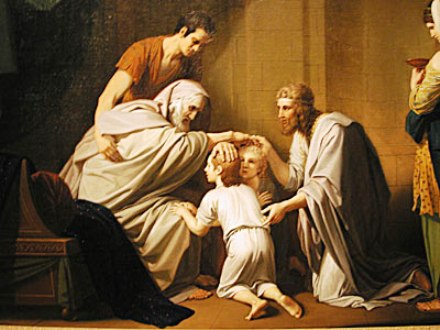
Genesis 48 - What matters most in a father

Pray and Read: Genesis 48

Contextual Notes: You have heard the story of Joseph, how he was hated by his brothers, sold as a slave into Egypt, then elevated to the prime minister of the greatest superpower of the ancient world. When famine struck, his brothers came to buy grain in Egypt, and eventually Joseph’s whole family came to live in Goshen, the best part of Egypt. In today’s story, Jacob is very old and on his death bed. Joseph comes to see him with his sons, Ephraim and Manasseh. Jacob takes the opportunity to do what matters most as a father.


Key Truth: Moses wrote Genesis 48 to teach the Israelites how to be a father.


Key Application: Today I want to show you what God’s Word says about what matters most as a father.


Sermon Points: What matters most as a father
1.
Being there for them (Genesis 48:1-2)
2.
Having a relationship with the Lord (Genesis 48:3-4)
3.
Providing for them as your own (Genesis 48:5-6)
4.
Being affectionate with them (Genesis 48:7-11)
5.
Pointing them toward the Lord (Genesis 48:12-14)
6.
Blessing them (Genesis 48:15-20)
7.
Leaving them a legacy (Genesis 48:21-22)


Exposition: Note well,


1. BEING THERE FOR THEM (GENESIS 48:1-2).


a. Though Jacob was ill, and apparently on his death bed (48:21), he sat up and took all his strength to do what was important to him.


2. HAVING A RELATIONSHIP WITH THE LORD (GENESIS 48:3-4)


a. If you do all the rest and do not give them an example of living the life of a believer before them, you have failed. Do you have a genuine relationship with him? Or did you just walk down an aisle once, go through the water, and other than that you haven’t acted like a believer since?


3. PROVIDING FOR THEM AS YOUR OWN (GENESIS 48:5-6)


a. Since Jacob would have no more sons by his dear wife Rachel, he adopted his grandsons as his own, giving them the rank and position of his other sons. Sometimes as believers we must raise our grandchildren as our own. Sometimes we are called to raise someone else’s child as our own. Sometimes we are called to adopt a child as our own. If you find yourself in that position today, receive them and provide for them as you would your own child.


4. BEING AFFECTIONATE WITH THEM (GENESIS 48:7-11)


a. Both boys and girls need that affection from you, Dad. Sometimes we back away from showing affection, hugging and kissing them, but they need it. It tells them they are safe and that you accept them.


b. Do you know what your little girls need from you, dad? They need to hear you tell them a thousand times over that they are beautiful. They need to hear it from you over and over and over. That provides security for them that their dad thinks they are beautiful.


c. Do you know what your boys need to hear from you, dad? They need to hear that they can do it. That they count for something. That they can accomplish and achieve what is before them. That you believe in them and you believe they can do it. That communicates to them the confidence they need. It instills in them a healthy sense of manhood and security that they can meet challenges.


5. POINTING THEM TOWARD THE LORD (GENESIS 48:12-14)


a. In verse 14, Jacob crosses his arms, making a sign of the cross, a prophecy of the Cross of Jesus Christ. In fact, Ephraim represents the Gentiles who are a "group of nations" (48:19) who will come to faith in the God of Israel, who is Jesus Christ. Manasseh, the firstborn, represents the Jews who will come to faith in Yeshua as their Messiah second.


6. BLESSING THEM (GENESIS 48:15-20)


a. How do we bless them? Jacob was speaking prophetically over the boys Manasseh and Ephraim. He was predicting the blessing that they one day would become, how they would be protected by the Lord, and how they would increase. b. Many children only hear that they are worthless, that they were a mistake, that they were never wanted, that they will never amount to anything. That records in their spirits and lasts their lifetime. You know it’s true. Because there are hurtful things you heard years ago when you were a child from someone, perhaps a mom or dad, that still hurts after all these years.


7. LEAVING THEM A LEGACY (GENESIS 48:21-22)


a. What happens when you are gone? What will you leave your children? I’m not talking just about money and stocks and land. They might squander that. I’m talking about a spiritual legacy which doesn’t rot or depreciate or get taxed. Will they curse you when they remember you? Will you leave them anything that you accomplished? Anything to make them proud that you were their dad or granddad? Will they praise you for a characteristic you have? Will you leave them something of moral strength to help them through tough times and provide for them?


Invitation: The good news is that Jesus Christ has provided the only way to salvation for me and you and your children. Have you told your children about Jesus? Today is the day to share the good news of Jesus Christ with them on this day you as a dad are honored. Today is the day to build on that legacy you will leave them when you’re gone. Today is the day to make a fresh commitment to Jesus Christ to be what matters most in a father.

Tuesday, June 16, 2009

Union Church

Sign says, "We welcome our new pastor Gene Brooks and his family."

Union Missionary Baptist Church (SBC), Rocky Mount, NC

Sunday, June 14, 2009

Rachel today

John Lennox on science & religion

John Lennox is a professor of mathematics at the University of Oxford and a Bible-believing Christian.

Saturday, June 13, 2009

NonWestern missionary sending

Hwa Yung, a bishop in the Methodist Church of Malaysia and former director of the Centre for the Study of Christianity in Asia at Trinity Theological College, Singapore, recently wrote an article for the Lausanne Committee for World Evangelization. (Excerpts follow - Full article here).

Yung attended the global mission conference, Ethne06, held in Bali in 2006, where some of the major mission networks from the non-Western world reported their long range plans.

COMIBOM reported that by 2005, Latin American churches had sent out some 8,000 missionaries to over 150 countries. And more are in the pipeline.

African churches were not to be outdone. For example, Timothy Olonade of the Nigerian Evangelical Missions Association noted that the Nigerian churches have sent out 5,200 missionaries to date. By 2020, their goal was to send out 50,000 missionaries.

Dr. Kang Sung Sam of the Korea World Missions Association reported that Korean churches have sent out 18,000 missionaries to date. By 2030, they hope to send 100,000.

The Indian Missions Association, under Dr. K. Rajendran, covered 208 mission agencies with more than 30,000 cross-cultural missionaries. Most of these are working within India’s borders, but a growing number are overseas.

Then there is the “Back-to-Jerusalem” movement of China’s house churches, based upon a vision that first emerged in the 1920s. The goal is to send out 100,000 missionaries within this generation along the ancient trade routes back to Jerusalem, going through the heartlands of Buddhism, Hinduism, and Islam along the way. Again, the Philippines Council of Evangelical Churches speaks of sending out 200,000 tentmakers in the form of migrant workers by 2010.

Friday, June 12, 2009

Pray for Iranian elections today

For many Christians in the rapidly growing church in Iran, Friday's presidential election could be life-altering.

The underground Iranian church has experienced unprecedented growth in the last 10 years despite tremendous persecution under hard-line Muslim President Mahmoud Ahmadinejad. Believers are praying that new leadership would grant them religious freedom.

"Last year has been one of the toughest years on the growing house-church movement in Iran," Paul Estabrooks of Open Doors said. "More than 50 house-church leaders were arrested. There has been a strong crack down against the growing house church, and the reason of course is that the church is growing so fast."

A 2008 apostasy law making conversion from Islam a capital offense passed Iran's Parliament. Though currently awaiting Parliamentary council review, the law could be enacted during the first months of the next presidency. If enacted, conversion from Islam would mean the death penalty for men and life in prison for women.

Many believers say they converted from Islam after having dreams of Christ. Most new Christians are young adults who are evangelizing their peers at impressive rates and are hopeful about their future.

"The large growth of the church is predominantly among young people in Iran, and they have great hopes for a better future in their land--for believers and for the church," Estabrooks said.

Pray for freedom and relief for Christian believers in Iran who number several times more than the official government count of 300,000. Pray for strength to endure imprisonment and abuse well. Pray for many more to come to know the true freedom found only in Jesus Christ.

Full source article here

Thursday, June 11, 2009

Judeo-Christian Nation

Responding to President Obama's recent statement in Cairo, Congressman Randy Forbes, 4th District Virginia, addresses the Congress on whether the United States is a Judeo-Christian nation. Do you agree or disagree? Comment below.

Wednesday, June 10, 2009

New Book Smell

I'd like a can of old book smell, too, please.

Tuesday, June 09, 2009

South Carolina State Seal


THE South Carolina STATE SEAL
Left side: The palmetto tree springs from a fallen oak tree, which represents the British ships that South Carolina patriots defeated at Sullivan's Island in 1776. The shields on the palmetto trunk give the dates of the Declaration of Independence (4 July 1776) and the date that South Carolina adopted its first state constitution (26 March 1776). The motto on the banner means "who shall separate?" The words under the tree trunk translate to "Having fallen it has set up a better." ANIMIS OPIBUSQUE PARATI means "Prepared in mind and resources."

Right side: The woman represents hope overcoming danger, and the laurel branch in her hand symbolizes the victory at Sullivan's Island. SPES means hope. DUM SPIRO SPERO means "While I breathe, I hope". DUM SPIRO SPERO and ANIMIS OPIBUSQUE PARATI are the state mottoes.

If you have questions about the history of South Carolina or wish to do historical research, please visit the South Carolina Archives

Monday, June 08, 2009

R.E. Lee on the Bible


"In all my perplexities and distresses the Bible has never failed to give me light and strength."

Robert E. Lee

Sunday, June 07, 2009

Numbers 11:1-3 - Fire at Taberah

Pray and Read: Numbers 11:1-3
11:1 Now the people became evil complainers in the hearing of YHWH, and when YHWH heard it, his anger was kindled, and the fire of YHWH blazed up among them and devoured the outskirts of the camp. 11:2 The people cried out to Moses, and Moses interceded on (their) behalf to YHWH and the fire died out.
11:3 So the name of that place was called Taberah (burning) because the fire of the Lord burned among them.


Contextual Notes:
The camp of Israel has left Sinai and is on the move, and we enter now a section of Scripture, Numbers 11-14, which is a time of complaining and rebellion that will culminate in Israel’s rebellious refusal to go into the Promised Land. It is at the same time a section of the patience and grace of the Lord.
That rebellion of Israel begins here and will build to Numbers 14. Today we look at the first scene.

Key Truth: Moses wrote Numbers 11:1-3 to warn Israel against rebellion and to prophesy to them Jesus the Messiah whose intercession rescues us from eternal fire.

Key Application: Today I want to show you what the Bible warns about rebellion and how Jesus’ intercession rescues us from Hell’s fire.

Sermon Points:
1. Rebellion stirs up destroying fire (Numbers 11:1)
2. Christ quenches the destroying fire (Numbers 11:2-3)

Exposition: Note well,

1. REBELLION STIRS UP DESTROYING FIRE (11:1).

a. כְּמִתְאֹ֣נְנִ֔ים Hithpoel participle: complainers
b. What did they complain of?
i. Was it their direction? It was toward the Promised Land, the home God had promised them.
ii. Was it the length of travel? They had only gone three days (10:33).
iii. Was it the food? It was miraculously provided bread (manna) twice a day.
iv. Did they want to return to Egypt (Num 11:4)? Jarchi, a great Jewish commentator, says the word complainers signifies taking an opportunity, and that the sense is, that these men sought an occasion how to separate from the Lord; they wanted to return to Egypt again, that was what they were meditating and contriving; so the Targum of Jonathan reads, "and the ungodly of the people were in distress, and intended and meditated evil before the Lord:"

c. These complainers were creating dissension in the congregation. They were stirring up trouble. They were apparently on the outskirts. Isn’t that just the way they work? They hang around on the edge of what is going on and second guess, nay say, and complain.

d. "it displeased the Lord": a murmuring complaining spirit is always displeasing to him, when a thankful heart for mercies received is an acceptable sacrifice; murmurers and complainers God will judge at the great day,
e. and consumed the outskirts of the camp; who very likely were the principal aggressors; or it began to arouse and terrify the body of the people, and bring them to repentance, who might fear it would proceed and go through the whole camp, the hinder part or rearward of which was the camp of Dan; and so the Targum of Jonathan.
f. Same fire as killed Nadab and Abihu; Leviticus 10:1. This is another form of strange fire.

g. APPLICATION: Let me tell you how you can spot a rebellious person, how you can put your finger on a person creating dissension in the congregation. It doesn’t matter what the circumstances are, they will have something to complain about it, and they poison everyone they come in contact with. These kinds of people slime you, and you feel just a little dirty after you walk off from their sewage-spewing mouths.

h. Not around for the work: A person creating dissension will also never be found where the real work is going on, unless there is something they can get out of it. They stay out at the outskirts of the camp. You’ll find them standing outside spewing their filth. They’ll pull you in to a conversation you didn’t want to be part of. You’ll come around a corner and see them whispering their poison, putting out their lies, tearing apart somebody. Unless you want to get burned with their strange fire, you best stay away from them. Or if you are in leadership or a supervisory role, your job is to confront it and stop it.

i. Look for an occasion to separate: Another thing is that a person creating dissension is always looking for an occasion, always looking for a cause, always looking for an opportunity to pounce on something or somebody. They have a famous relative. We read about him in 1 Peter 5:8: “Your enemy the devil prowls around like a roaring lion looking for someone to devour.” This kind does the same thing. They love innuendo. They like to put half a sentence out there to create a question in your mind. They are constantly looking for a way to twist someone’s words or wrench around a situation to suit their own agenda to make their point, to put somebody in their place, and out of their own insecurity try to make themselves look better than the one they just devoured.

j. Strange Fire: The Scripture says that fire is reserved for those kinds of people. What is sad is that in the church we have leadership, people who are supposed to have the maturity and sense and salvation to stop dissension when they see it, but sometimes they are the ones running around stirring things up to the detriment of everybody else. That kind of activity is called strange fire. It killed Nadab and Abihu. It killed those on the outskirts. And if you traffic in strange fire, it will burn you, too.

k. Some of you might not like what I have to say today, but you will have to take it up with the Almighty and His Book. Oftentimes the Word says things that make me uncomfortable. It is called conviction. If it makes you uncomfortable or angers you, perhaps you should pay more attention. The Holy Spirit is trying to help you overcome yourself. If the Lord doesn’t lead you to passages where He is trying to help you grow and develop and move the obstacles out of the way to that growth, then you’re not reading the Scripture enough. Has it ever occurred to you that there are some messages that the preacher does not want to bring? But to be a faithful servant, bring them he must.

l. But the best part of this passage comes next. In verses 2 & 3 there is some great good News.

2. CHRIST QUENCHES THE DESTROYING FIRE (11:2).

a. “Moses prayed unto the Lord”; as he did, in which he was a type of Christ, the mediator between God and man, the advocate of his people, an intercessor for transgressors.

b. Isaiah 53:12: he was numbered with the transgressors; and he bare the sin of many, and made intercession for the transgressors.

c. 1 Timothy 2:5-6: For there is one God, and one mediator also between God and men, the man Christ Jesus, who gave Himself as a ransom for all.”
d. Romans 8:34: It is Christ that died, yea rather, that is risen again, who is even at the right hand of God, who also maketh intercession for us.
e. Hebrews 7:25: Wherefore he is able also to save them to the uttermost that come unto God by him, seeing he ever liveth to make intercession for them.

f. “the fire was quenched”; it stopped and proceeded no further; as through Christ's mediation God is pacified with his people for all that they have done, and his wrath, and all the effects of it, are turned away from them, and entirely cease with respect to them; or it "sunk down" (תשקע "sunk down") into its place. This may serve to confirm the notion of its being a burning wind, to which the idea of sinking down and subsiding well agrees. Perhaps it could have been a desert wind and sand storm, but the passage does not use the common Hebrew word for wind, ruach. It says fire.

g. “because the fire of the Lord burnt among them”; It was called Burning (Taberah) to perpetuate the memory of this kind of punishment for their sins, that it might be a terror and warning to others; and this history is indeed recorded for our caution in these last days, that we murmur not as these Israelites did, and were destroyed of the destroyer, 1 Corinthians 10:10: “nor grumble, as some of them did, and were destroyed by the destroyer.”

h. APPLICATION: As a believer do you find yourself under the conviction of the Holy Spirit for rebellion and running your mouth too much?
i. Do you carry tales? Do you enjoy innuendo?
ii. Do you say enough to bring up doubt in people’s minds but not enough to incriminate yourself?
iii. Are you a divider? A separator of friends? Or churches?
iv. If so, one of two things could be happening. You could be living in the flesh or carnality which is sin. Or you could be bound by the evil one. An example of such a person who has tasted salvation but is bound by his own bitterness is Simon bar Jesus in Acts 8.

i. Moses is a picture of Christ Jesus and what He did for us on the cross at Calvary. By His death and resurrection, Jesus purchased for each one of us the free gift of eternal life, salvation full and free. Jesus Christ has paid for our rebellion. He has overcome our sin. He has quenched the flame that was set to destroy us! Hallelujah!

i. Where do you stand with him? Do you know about Him? Or do you know Him?
ii. Do you just have all your doctrine and beliefs in your head about Him correct? Or do you have the strings of your heart tuned to Him?
iii. Have you only a long time ago made a decision for Christ? Or have you given your life in submission to Christ?
iv. Did you only once pass through the waters of baptism? Or do you live your life immersed in His Presence?
v. Are you a simply a member of the church? Or are you a blood-bought child of the Kingdom?
vi. Do you believe yourself to be at root a good person? Or have you recognized your own depravity and claimed the sin payment provided only by the Lord Jesus Christ?
vii. If you cannot tell the difference in what I’m saying to you, then you need to do some serious self evaluation during the next few minutes. And you need to consider responding to the invitation when I give it at the end of this message.

Invitation:
This passage is a warning to us. If we persist in rebellion against the throne of the Mighty God, we have nothing to expect except a fiery eternity, separated from God, in total misery and endless suffering. Hell is a real place, and it is reserved for every person who is rebellious, not because the Lord wants anyone to be there or elects anyone to be there, but because His character will not abide sin and rebellion. Are you safe from that eternal fire, or are you a rebel?

Christ is your intercessor. He ever lives to intercede for you and for me. He has paid the price, but you must confess your sin. You must repent of your sin. You must turn to Christ and lay your whole life before Him. You must submit to His authority in your life. It is what is called, “Giving your life to Jesus.”

But be forewarned today, that if you do not accept the free gift of eternal life, you will be destroyed by fire. This is a serious matter of the first magnitude. You will be sentenced to eternity in a miserable hell. You will be cut off from every mercy and every grace forever. And I’m not talking just to a pagan here or there among us. There are good, church-going Baptists who die and bust hell wide open every day of the week.

Today the Lord’s arms are outstretched to every rebel. To you who have lived a life of rebellion against His Name. To you who creates dissension in the congregation. To you who are filled with sin. He can remove it. He is right now interceding on your behalf to remove the fire which will destroy you. Won’t you receive Him? Won’t you cry out to Him like the children of Israel did? Won’t you do it right now?

Friday, June 05, 2009

Canadian PM on Israel

North of the border, Canada's chief executive still has a decent respect for the nation of Israel. Here is what Canadian Prime Minister Stephen Harper said last week:

"As you know, our government is not always of one mind with the Government of Israel on the issues of the Middle East. But friends, I am very troubled by the degree to which opposition to the Government of Israel has become, in some circles, an intellectually respectable cover for anti-Semitic discourse.

It is all too common nowadays for politicians to claim to support Israel and the Jewish people in forums such as these. Yet, when Israel is attacked, for the umpteenth time, because its enemies refuse to accept the right of the Jewish state to exist, these same politicians are quick to condemn Israel, accuse it of war crimes, and demand that it unilaterally suspend its right to self-defence.

You will not hear that kind of double-speak from our Government, ever."

At least the Canadians have a chief executive who is is not a turncoat on traditional, fellow-democratic allies. Below is Dick Morris' comments on the Obama administration's work against Israel.

Thursday, June 04, 2009

Objection to Biblical Inerrancy #10

Continued from Objection to Biblical Inerrancy #9

A tenth objection
comes from a sociological study published in the Journal of Politics in 2008. Their charge is that inerrancy engenders a messianic militarism that emerges in political right-wing nationalism, hierarchical authority, devotionalism, immersion in traditionalist Christian culture, and a focus on foreign policy issues over domestic.[1]

While inerrantists should be so flattered as to be accused of so many things simply because they have a high opinion of a religious book, such an objection is slightly contradictory in itself. It asserts that belief in inerrancy makes one both provincially nationalistic and also highly focused on foreign policy. Perhaps instead the
foreign policy focus means that the more people believe the Bible, the more they have a heart for the nations and for others.

The study rightly argues that many Christians are ensconced within their own Christian cultural bubble. I would add that immersion within traditionalist Christian culture is not ideal for vigorous and effective evangelism. Perhaps instead someone should study why Christian believers are unappreciative of researchers' blatant disdain for all things Christian and how they therefore refrain from participating in biased
studies derogatory of their belief and their Lord.

The term hierarchical authority in this Journal of Politics study probably refers to a biblical pattern of a two-parent family led by the husband, a pattern which worked quite well for the development of society and civilization throughout all world history until the last fifty years -- an open and free civilization that now gives these researchers the right to publish such religious bigotry. And what of their charge against devotionalism? Devotionalism is a good thing and an indication that an inerrantist actually lives what he says he believes.


[1] David C. Barker, Jon Hurwitz, and Traci Nelson. “Of Crusades and Culture Wars: ‘Messianic’ Militarism and Political Conflict in the United States.” The Journal of Politics 70 (2008): 307-322. doi:10.1017/S0022381608080328. Accessed November 25, 2008; available from http://journals.cambridge.org/action/displayAbstract?fromPage=online&aid=1818056

Continue on to Objection to Biblical Inerrancy #11

Also on Sunday in the South:

Objections to Biblical Inerrancy #1 & #2, #3 & #4, #5, #6, #7, #8
, #9

Wednesday, June 03, 2009

The Church's global shift


By 2025, there will be as many Christians in ­sub-­Saharan ­Africa—­some 640 ­million—­as in South America. By 2050, it is almost certain that most of the world’s Christians will live in Africa.

As Kenyan scholar John Mbiti writes, “The centers of the church’s universality [are] no longer in Geneva, Rome, Athens, Paris, London, New York, but Kinshasa, Buenos Aires, Addis Ababa, and Manila.”

Source: Wilson Center

Tuesday, June 02, 2009

Western birthrates improve to "steady"

Recently we ran a youtube video on Europe's birthrate and subsequent cultural decline in the face of high birth rates among Muslims.

The Woodrow Wilson Center has published a counter perspective stating that Muslim birthrates are also declining in Europe.

A few quotations of note:

Something dramatic has happened to the world’s birthrates. Defying predictions of demographic decline, northern Europeans have started having more babies. Britain and France are now projecting steady population growth through the middle of the century. In North America, the trends are similar. In a society in which an average woman bears 2.1 children in her lifetime—what’s called “replacement-level” ­fertility—­the population remains stable.

One fact that gets lost among distractions such as the Times story is that the birthrates of Muslim women in Europe—and around the world—have been falling significantly for some time. Data on birthrates among different religious groups in Europe are scarce, but they point in a clear direction. Between 1990 and 2005, for example, the fertility rate in the Netherlands for Moroccan-born women fell from 4.9 to 2.9, and for ­Turkish-­born women from 3.2 to 1.9. In 1970, ­Turkish-­born women in Germany had on average two children more than ­German-­born women. By 1996, the difference had fallen to one child, and it has now dropped to half that number.

The decline of Muslim birthrates is a global phenomenon. Only two Arab countries still have high fertility rates: Yemen and the Palestinian ­territories. In some Muslim ­countries—­Tunisia, the United Arab Emirates, Bahrain, Kuwait, and Lebanon—fertility rates have already fallen to ­near-­European levels. Algeria and Morocco, each with a fertility rate of 2.4, are both dropping fast toward such levels. Turkey is experiencing a similar trend.

In Indonesia, the country with the world’s largest Muslim population, the fertility rate for the years 2010–15 will drop to 2.02, a shade below replacement level. The same UN assessment sees declines in Bangladesh (to 2.2) and Malaysia (2.35) in the same period. By 2050, even Pakistan is expected to reach a replacement-level ­fertility rate.

Iran is experiencing what may be one of the most dramatic demographic shifts in human history. Thirty years ago, after the shah had been driven into exile and the Islamic Republic was being established, the fertility rate was 6.5. By the turn of the century, it had dropped to 2.2. Today, at 1.7, it has collapsed to European levels. The implications are profound for the politics and power games of the Middle East and the Persian Gulf, putting into doubt Iran’s dreams of being the regional superpower and altering the tense dynamics between the Sunni and Shiite wings of Islam. Equally important are the implications for the economic future of Iran, which by ­mid­century may have consumed all of its oil and will confront the challenge of organizing a society with few people of working age and many ­pensioners.

Across northern and western Europe, women have suddenly started having more babies. Germany’s minister for the family, Ursula von der Leyen, announced in February that the country had recorded its second straight year of increased births. Sweden’s fertility rate jumped eight percent in 2004 and stayed put. Both Britain and France now project that their populations will rise from the current 60 million each to more than 75 million by ­mid­century. Germany, despite its recent uptick in births, still seems likely to drop to 70 million or less by 2050 and lose its status as Europe’s most populous country.

In Britain, the number of births rose in 2007 for the sixth year in a row. Britain’s fertility rate has increased from 1.6 to 1.9 in just six years, with a striking contribution from women in their thirties and ­forties—­just the kind of hard-to-predict behavioral change that drives demographers wild. The fertility rate is at its highest level since 1980. The National Health Service has started an emergency recruitment drive to hire more midwives, tempting early retirees from the profession back to work with a bonus of up to $6,000. In Scotland, where births have been increasing by five percent a year, Glasgow’s Herald has reported “a mini baby boom.”
In 2007, France’s national statistical authority announced that the country had overtaken Ireland to boast the highest birthrate in Europe. In France, the fertility rate has risen from 1.7 in 1993 to 2.1 in 2007, its highest level since before 1980, despite a steady fall in birthrates among women not born in France. France’s National Institute of Demographic Studies reports that the immigrant population is responsible for only five percent of the rise in the ­birthrate.

A similar upturn is under way in the United States, where the fertility rate has climbed to its highest level since 1971, reaching 2.1 in 2006, according to the National Center for Health Statistics. New projections by the Pew Research Center suggest that if current trends continue, the population of the United States will rise from today’s total of some 300 million to 438 million in 2050. ­Eighty-­two percent of that increase will be produced by new immigrants and their U.S.-born descendants.

By contrast, the downward population trends for southern and eastern Europe show little sign of reversal. Ukraine, for example, now has a population of 46 million; if maintained, its low fertility rate ­will whittle its population down by nearly 50 percent by mid-century. The Czech Republic, Italy, and Poland face declines almost as ­drastic.

In Russia, the effects of declining fertility are amplified by a phenomenon so extreme that it has given rise to an ominous new ­term—­hypermortality. The report ­predicts that within little more than a decade the ­working-­age population will be shrinking by up to one million people annually. Russia is suffering a demographic decline on a scale that is normally associated with the effects of a major ­war.

Perhaps the most striking fact about the demographic transformation now unfolding is that it is going to make the world look a lot more like Europe. The world is aging in an unprecedented way. A milepost in this process came in 1998, when for the first time the number of people in the developed world over the age of 60 outnumbered those below the age of 15. By 2047, the world as a whole will reach the same ­point.