Showing posts with label The South. Show all posts

Thursday, December 31, 2015

The New Years Black Eyed Pea Tradition

Dry Black-eyed peas
Dry Black-eyed peas (Wikipedia)
Originally brought to America by African slaves, the black eyed pea has become in Southern folklore a food item to be eaten on January 1st each year for good luck. But there is more to the story.

"The real story is much more interesting and has gone untold in fear that feelings would be hurt. It’s a story of war, the most brutal and bloody war, military might and power pushed upon civilians, women, children and elderly. 

Never seen as a war crime, this was the policy of the United States government to subjugate the South at all costs. 

The story of THE BLACK EYED PEA being considered good luck relates directly back to Sherman's Bloody March to the Sea in late 1864. It was called The Savannah Campaign and was led by Major General William T. Sherman. The Civil War campaign began on November 15, 1864, when Sherman's troops marched from the captured city of Atlanta , Georgia , and ended at the port of Savannah on 12/22/1864.


When the smoke cleared, the southerners who had survived the onslaught came out of hiding. They found that the blue belly aggressors had looted and stolen everything of value and everything you could eat including all livestock. Death and destruction were everywhere. While in hiding, few had enough to eat, and starvation was now upon the survivors.

There was no international aid, no Red Cross meal trucks. The Northern army had taken everything they could carry and eaten everything they could eat. But they couldn’t take it all. The devastated people of the South found for some unknown reason that Sherman’s bloodthirsty troops had left silos full of black eyed peas.

At the time in the North, the lowly black eyed pea was only used to feed stock. The Northern troops saw it as the thing of least value. Taking grain for their horses and livestock and other crops to feed themselves, they just couldn’t take everything. So they left the black eyed peas in great quantities assuming it would be of no use to the survivors, since all the livestock it could feed had either been taken or eaten.

Southerners awoke to face a new year in this devastation and were facing massive starvation if not for the good luck of having the black eyed peas to eat. 


From New Year’s Day 1866 forward, the tradition grew to eat black eyed peas on New Year’s Day for good luck." 

Saturday, August 15, 2015

A Primer on South Carolina's Reconstruction

A view of SC's Reconstruction General Assembly
Our series on Laurens County, SC, during Reconstruction continues with a primer on SC Reconstruction history. 

In order to better understand Laurens County’s role in South Carolina Reconstruction history, a short overview of Reconstruction across the state may be helpful.
        After the Confederacy fell in April 1865, SC Governor A.G. Magrath was removed by the victors and sent to Federal prison. U.S. President Andrew Johnson, who was taught to read and write in Laurens County many years earlier by a young sweetheart, pardoned most of those who had taken part in the war. He also appointed Benjamin F. Perry of Greenville as provisional governor. Perry was a Unionist who had opposed both nullification and secession, but he also held the respect of many South Carolinians. Perry immediately

Thursday, July 16, 2015

Legal Fallout from the Laurens, SC, Riot

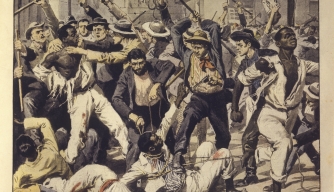
Our series on Laurens County, SC, during Reconstruction continues, with a description of the legal fallout in the wake of the Laurens, SC, Riot of 1870. Racial and political tensions in post-War South Carolina continued to boil over in the Upstate. The first round of arrests and trials began. Here is the story:

The fallout came quickly from the Laurens and Clinton Riots and the successive dark and violent days of 1870. In January 1871, several Laurens and Clinton men were arrested by the State Constabulary and indicted under the Enforcement Acts. 

They were hauled before the federal Grand Jury in Columbia. By blackmailing the wealthiest in the county, "it was thought that these gentlemen, with the prospect of the penitentiary immediately before them, would 'pay out' handsomely."

Friday, June 26, 2015

Days of Terror in Laurens County, SC

Our series on Laurens County, SC, during Reconstruction continues, with a description of the days of terror in the wake of the Laurens, SC, Riot of 1870.

The Laurens Riot took place October 20, 1870, the day after the general election, and racial and political tensions in post-War South Carolina were bound to boil over somewhere. The account of the Laurens Riot is found here, but the aftermath was even darker. Here is the story:


By nightfall the whole thing seemed to be over, that is until riders from surrounding counties and outlying areas came into Laurens and into the barrooms in Clinton,[1] having heard the rumors flying of race war.

Wednesday, May 27, 2015

The Clinton, SC, Riot of 1870

The Clinton, SC, Square.
Our series on Laurens County, SC, during Reconstruction continues, with 1870 election tensions building to a race riot in Clinton.

In Laurens County and throughout South Carolina, as the 1870 fall election season approached, tensions continued to increase, fomented by outside political influences and internal racial fears. 

On a dark night in mid-August, Dr. William P. Jacobs of Clinton, SC, was in for a real surprise on his way home from Cross Hill after marrying a couple.

Wednesday, December 10, 2014

The economy in post-War Laurens County, SC

Map of South Carolina highlighting Laurens County
Laurens County in South Carolina (Wikipedia)
ECONOMICS AND GENERALITIES AT WAR'S END
Let’s begin by looking at the realities of Laurens County’s economy and generalities of life at the end of the War for Southern Independence.  

The poverty which the post-bellum Confederate was to know was first of all a direct result of the North's hatred and blatant destruction of the South. But there was an element of the poverty that the slave owner brought upon himself.  Before the war, men would live not much better than their slaves in order to

Saturday, May 10, 2014

Confederate Memorial Day


My college friend and my wife's cousin, Bill Heuble wrote the following note to his child's school teacher in Greenville, SC, a few years ago. We share it here with Bill's permission for today, Confederate Memorial Day in North and South Carolina, the anniversary of the death of Lieutenant General Thomas Jonathan Stonewall Jackson, May 10, 1863.

Saturday, January 19, 2013

The Departure of Secesh Women for Richmond

Photo: The Departure of Secesh Women for Richmond.

One day last week the steamer New York took 450 women and children from Washington to the realms of Secessia. They all had, or claimed to have, friends or relatives in Jeff Davis’s kingdom, and were sent South at Government expense. Among the number were several young women whose departure from the Federal capital will lighten the duties of the provost-marshal. The Washington Star says:

Had their baggage passed without inspection they would have added much also to the necessities of the Southerners in dry goods, shoes, medicines, and many other articles and goods much required at the present time in Jeff Davis’s domains. Eight officers were engaged all last night in examining the baggage that had been sent down. In many of the trunks were found dress goods of various kinds and textures, pins, needles, thread, etc., which articles were, of course, excluded.

In one very large trunk a sufficient quantity of dry goods was found to fully stock a country store. Some of the trunks had ten, fifteen, and as high as twenty-five. pairs of shoes. No passenger, however, was allowed to take more than two pairs. One lady, when asked why she desired to take so many, replied that she generally wore out two pair per month! All this morning the wharf and the neighborhood of Sixth Street was crowded with ladies and gentlemen, who resorted there to witness the departure and for the purpose of saying farewell to friends.

Judging from the expressions we heard in the crowd secesh sympathizers predominated. A gentleman asked an old lady who was going off whether she was pleased at her departure. She replied, “Yes, thank God! it is a great pleasure to get to a Government conducted by gentlemen, and not by Yankee boors.” A crowd immediately gathered around, and then commenced expressions of contempt from fair lips for the United States Government generally, and the President and Cabinet in particular. One young lady remarked to a friend as she bade her good-by, “Be sure and write quickly; you know how to get the letter through.” Another lady remarked that she hoped to return ere long, but with the victorious Confederate army.

(Published January 24, 1863, in Harper’s Weekly.)

http://dotcw.com/the-departure-of-secesh-women-for-richmond/150 years ago this past week:

"One day last week the steamer New York took 450 women and children from Washington to the realms of Secessia. They all had, or claimed to have, friends or relatives in Jeff Davis’s kingdom, and were sent South at Government expense. Among the number were several young women whose departure from the Federal capital will lighten the duties of the provost-marshal. The Washington Star says:

Saturday, January 05, 2013

Flag of Gaston Blues, Co. H, 37th NCST

The flag of the Gaston (NC) Blues, Co. H, 37th NC State Troops

The Gaston (County) Blues mustered into Confederate service as Company H, 37th North Carolina Infantry, forming a part of Lane's North Carolina Brigade, and participated in all major actions of the Army of Northern Virginia from their baptism of fire at New Berne, NC, on 14 May, 1862--to the end of the war--including Manassas, Fredericksburg, Chancellorsville, and Gettysburg where the unit suffered heavily in the Confederate assault on the Union center on the afternoon of July 3.

Colonel Barbour, the regiment's commander, stated in a report shortly after the Gettysburg Campaign, that "The regiment has lost one hundred and fifty men killed, seventy who have died of wounds, three hundred and two who have died of disease, and three hundred and thirty two have been wounded and recovered. Total loss killed and wounded, five hundred and fifty two....Fourteen officers of this regiment have been killed or mortally wounded... There are but six officers in the regiment who have not been wounded, a large number (both officers and men) have been wounded more than once." Stark testimony to the battle history of the Fighting Thirty-seventh.

For more information, see the Gaston Blues History and Roster and the 37th NC: Gaston Blues page.

Friday, December 21, 2012

Stonewall Jackson: "War is the greatest of evils"

T.J. Stonewall Jackson, 1862
“War is the greatest of evils.” --- Stonewall Jackson to Jedediah Hotchkiss about December 21, 1862. 

Hotchkiss later wrote, “At night had a [long] talk with the General [Stonewall Jackson], at his quarters, especially about the war. He lamented the calamities it had brought upon Fredericksburg; said: ‘War is the greatest of evils.’ 

"He asked if I thought the troops could endure the cold weather, encamped as they now are and most of them without tents. Said he was much disappointed in the weather here; it was not as warm as he expected it would be. 

"He spoke of railroad accidents, one having happened today; said they presented the most horrid sights he had ever seen. 

"We talked of the [state] of religion in the North and in the South, and how Providence had blessed us, and how our strength had increased during the continuance of the war and up to this time.”

 Source: Jedidiah Hotchkiss, Make Me a Map of the Valley: The Civil War Journal of Stonewall Jackson's Topographer (Southern Methodist University Press, 1973), 102.

Sunday, October 02, 2011

Ephesians 2:11-22 - From Racism to Reconciliation

Pastors Michael Catt (l) & Daniel Simmons
Opening thought: 
This weekend the movie Courageous opened across the nation, a movie about men being the husbands and fathers God has called them to be. I urge you to see the movie which was was made by a Southern Baptist Church in Albany, Georgia, and pastored by Michael Catt. As a young white minister, Michael Catt was fired from a Mississippi church for quoting Martin Luther King, Jr. in the pulpit. He never forgot it.
“Getting fired … was really a pivotal, defining moment for me,” Michael Catt said.
Now 58, he’s the pastor of Sherwood Baptist Church in Albany, GA, and among a few churches taking steps to create – and maintain – the multi-ethnicity of Christ’s body nearly a half a century after King’s death.
When Catt became pastor of Sherwood Baptist in 1989, he noticed his predominantly white congregation was a stark contrast to the small city of Albany, whose population is about 65% black. He led the way in hiring its first black associate pastor. A tragic flood in Albany in 1994 eroded racial barriers even more and created a sense of unity that still exists today. Catt and his congregation reached out to the predominantly black Mt. Zion Baptist Church, which had been damaged by the flood.
There Catt met Senior Pastor Daniel Simmons, who is black, and the two forged a friendship and began swapping pulpits. Now, the two regularly preach at each other’s churches, and their congregations come together for those occasions.
Catt, Simmons and their mixed congregation are featured in the new movie Courageous, produced by Sherwood Baptist, ranked #1 in per theater ticket sales its first weekend.
“We learn from each other,” Simmons said of the two churches. “We mutually support and encourage each other.”[1]
Pastor Fred Luter
The Southern Baptist Convention a decade ago confessed the sin of racism and asked forgiveness. At the Convention this past June, messengers approved moving toward more racial diversity in its boards and committees. It also elected its first black First Vice President, Pastor Fred Luter of New Orleans, a position that traditionally prepares an SBC leader for the President’s chair.[2]
Contextual Notes:
Paul’s letter to the Ephesians is an awesome study of the church of Jesus Christ. In chapter 2 we see that God formed His church of flawed human beings, but He formed it out of His great love for sinners of all kinds (Eph. 2:1-4). He takes those who are dead in their sin and makes us alive in Christ, recreating us to make us suitable for the good works He prepared in advance for us to do (Eph 2:5-10). That regenerating, recreating work closed the gap between Jews, who enjoyed a covenant relationship with God, and the Gentiles, who were locked out of that relationship (Eph 2:11-13). By bringing both Jew and Gentile to God through the Cross, Jesus settled the long-standing hostility between the races, removing its cause (Eph 2:14-18). As a result, Jew and Gentile are now “fellow citizens” of God’s household and together parts of a holy temple that God’s Spirit is building even today (Eph. 2:19-22).

Key Truth: Paul wrote Ephesians 2:11-22 to teach believers that believers are people of reconciliation through Christ’s blood, Christ’s peace, and in Christ’s household.
Key Application: Today I want to show you what God’s Word says about racism and reconciliation.
Key Verse: Ephesians 2:14
Pray and Read:  Ephesians 2:11-22

Sermon Points:
1.   We are all reconciled in Christ’s blood (Eph 2:11-13)
2.   We are all reconciled in Christ’s peace (Eph 2:14-18)
3.   We are all reconciled in Christ’s household (Eph 2:19-22)

Thursday, August 18, 2011

Training at Baptism: Practically recovering regenerate church membership

"So, Mr. Tom, tell us why you think you're old enough."
Another area to help with regenerate church membership is a period of examination before and training after baptism. Examination is probing to understand if a person truly understands salvation and has submitted himself to Christ Jesus. 

Training is the initial disciple-making that is supposed to take place and is the church’s responsibility to provide. Examination and training were common in North Carolina Baptist churches a century ago, and continue to be important in other parts of the world today. Young children are one area to consider. 

As late as the early 1800s, during the tenure of the famous Richard Furman as pastor of First Baptist Church of Charleston, SC, children were carefully taught the church’s catechism, but “the greatest care was exercised in guarding against premature professions of piety.” Among earlier Baptists, the supposed conversion of someone under age 16-18 was considered unusual at best and more often suspect. Believer’s baptism was seen as synonymous with adult baptism. 

Baptism of children is rare among Baptists worldwide. The United States is the exception. Today, Baptists in Romania, Ukraine, Brazil, France, and nearly everywhere except the American South expect to baptize their young people no earlier than age 14.

In many of our Southern Baptist churches, while we do not practice infant baptism, we do practice toddler baptism. Between 1996 and 1993, baptisms of children under 6 years of age tripled. Recently, the only age group among Southern Baptists showing an increase in baptisms was preschoolers, a statistic not even kept until 1966. Certainly many had a genuine conversion, but many baptized as young children have never experienced a redeemed life. How do we know? 

We know because of the disturbing numbers of re-baptisms. A 1993 survey by the old Home Mission Board found that of adult baptisms (age 18+) in SBC churches, 3 of every 5 had been previously baptized. Some of course were coming from previous traditions, but 36% of all adults baptized in SBC churches in 1993 had been previously baptized in SBC churches. 

This is heinous. More than one third of those previously baptized Southern Baptists asked for re-baptism because they had just experienced conversion. It seems we are guilty of prematurely baptizing people, especially children, without insuring that they understand the gospel and are indeed responding to the leading of the Holy Spirit to submit themselves to Jesus Christ.

So what is a minimum age at which a child can be truly saved? That answer is impossible, but there is cognitive information in the Gospel that is beyond preschoolers’ concrete thinking skills. Art Murphy, Children’s Pastor at FBC, Orlando, says that “we have found that most children who make that decision under the age of 7 tend to need to make another decision later” and points to the high numbers of rebaptisms as evidence. Some people place a lot of emphasis on the age of 12. It is the age at which Jesus assumed spiritual responsibility (Luke 2:49); it seems to be the age at which Paul saw one as spiritually accountable (Rom. 7:9), what used to be called the age of accountability. It is the age of bar mitzvah and confirmation in paedobaptist churches). It is within the age-range that many developmental psychologists say significant cognitive abilities blossom. It was the age of conversion mentioned overwhelmingly in a Southern Baptist survey (more mentioned 12 than 11 and 13 combined; overall 67% were converted between 7 and 16).

How do we deal with a child age 4 or 5 who might come forward, who have asked Jesus into their hearts, and who are requesting baptism and church membership? First of all, we should encourage that child. At FBC, Dallas, young children making professions of faith are a cause for celebration that the Holy Spirit is at work in that child, but there is no hard conclusion drawn conversion has occurred nor that they should be immediately baptized. They take the attitude that the child has taken an important step in their relationship with Jesus, and a time is planned with the parents to further counsel the child.

God can move at any age in a person, but when does the church certify that? The church is in no way hurting him or keeping him from obedience. If his conversion was indeed genuine, then there is nothing the church can do to damage his salvation. If on the other hand, the church baptizes the child and receives him into church membership without a genuine conversion, then the church has hurt the child by providing a false sense of hope to him and his parents. Speaking as a pastor, usually it is the parents who want the pastor to do something who apply the pressure to baptize their child. The child is usually easily led in these circumstances. All the child wants is to be obedient to the Lord at that point. Here’s a rule of thumb: If a child is too young to read the church covenant, then he is probably too young to join the church!

Second, we need to be clear that salvation and baptism are separate issues. Salvation is God’s business, and he can save whomever he wants whenever he wants. Baptism is the responsibility of the church, and should occur only when the church has reason to believe that the one to be baptized has experienced salvation in Jesus Christ. Since baptism doesn’t complete salvation, there is no rush to baptize except to give a person freedom to partake in communion. Give the child’s commitment time to take root and grow and for the church to see evidence of new life in that little person. 

Third, some churches, like FBC Orlando, make baptism contingent on completing a four-week new Christian’s class and younger children are encouraged to grow and enroll in the class when they reach second grade. I don’t favor making baptism contingent on taking a class. In fact, I am growing in the idea that once converted one needs not to wait a long time to be baptized, but I like the idea of encouraging children to wait to be part of a new Christian’s class when they can, in fact, read the material presented to them! 

Some churches deal with that issue by baptizing children but adding other requirements to be a voting church member, such as age 16 or 18. Such a requirement seems to betray the idea that young children understand what they are doing. It doesn’t make sense that a congregation says a child can understand the most important decision of their lives at age 4 but they cannot understand how to vote on whether to pave the parking lot until they are 16.

Everyone who comes forward at an invitation should be warmly welcomed, but the church must take its responsibility seriously as a baptizing body. The church needs to have reason to believe the candidate for baptism is genuinely a believer. It is the church who decides who are to be church members, not the individuals coming forward. Christ Himself gave the church the competence and authority to make this decision, but we have exalted soul competence and neglected church competence. In order to make an intelligent vote on admitting someone to membership, they need some basis on which to vote.

Wednesday, August 03, 2011

Debt ceiling and the first income tax law

I thought it was ironic yesterday that President Obama signed the debt ceiling bill into law 150 years to the day of the passage by US Congress of the first income tax in American history, a sweeping new grab of federal power. 

The first income tax law was designed to tax the nation's wealthiest citizens -- a 3% tax on those making more than $800 per year. It was passed along with a new group of tariffs to finance the war effort to subjugate its own people's rights of self-determination. The tax increases were projected to raise $500 million to destroy the South, the region that until their secession had funded 80 cents of every dollar of the Federal government's operations.

The US Congress at the time of the beginning of the War between the States was a tool of the liberal Republican Lincoln Administration, passing sweeping changes and expansions of power for the Executive branch. It seems that liberals have always been after rich people's money.

Tuesday, July 26, 2011

SC Secession Flags

Here's a page I happened upon of South Carolina Secession and Battle Flags. 

Unfortunately they are missing the Laurens Briars flag given April 14, 1861, and now at the SC Confederate Relic Room at the State Museum. 

The Laurens Briars became Company G, Third Regiment, SC Volunteers, CSA. 

Pictured here is the SC flag hoisted over Fort Sumter after the battle April 15, 1861. 

Check out the Stoddard Family Letters from Laurens County, SC.

Monday, April 25, 2011

The influence of Charles P. McIlvaine


Richard G. Williams, Jr., who usually writes on his Old Virginia blog, has written a piece over at Civil War Gazette on the impact personal relationships have had upon history. 

"Even what may first appear as obscure and coincidental acquaintances often manifest themselves in profound ways regarding their impact on history," writes Williams, who specializes in the history of the Uncivil War and the Christian faith.

He illustrates his point with the life of Charles Pettit McIlvaine (1799-1873), an Episcopal minister of the gospel who, as the chaplain at the United States Military Academy at West Point, New York, preached the Good News of Christ and discipled the young men who later fought in the War between the States. In turn several of them encouraged and led in the Great Revival in the Confederate Armies in the winters of 1862, 63, and 64 when over 100,000 Southern boys came to know Jesus as their Lord and Savior.

McIlvaine was the son of New Jersey senator and a Princeton graduate. While studying at Princeton, McIlvaine came to faith in Jesus Christ along with many others in a campus-wide revival. Years later he wrote about the revival: “It was powerful and pervading and fruitful [in] the conversion of young men to God. In that precious season of the power of God my religious life began. I had heard before; I began then to know.”
After being ordained in the Episcopal Church in 1820, McIlvaine years later found himself as Chaplain of the U.S. Senate, regularly preaching to such luminaries as Kentucky Senator Henry Clay and lion of the Senate, John C. Calhoun from South Carolina. As Secretary of War, Calhoun appointed McIlvaine Chaplain of the U.S. Military Academy at West Point. 

At West Point, McIlvaine did his greatest work. In the 1826-27 school year, the Holy Spirit moved among the cadets. Francis H. Smith (Class of 1833 and the first superintendent of Virginia Military Institute) recounted later McIlvaine's description of the academy's spiritual climate:
“He said, when he entered upon his duties at West Point, the spiritual condition of the Institution was deplorable — no sense of religious obligation — but few professors of religion [that is, believers] among the cadets — and not more than one, if one, among the professors. Skepticism, in its varied forms, was prevalent among officers and cadets, and his labors for some time seemed to be in vain. He finally determined he would combine, with his pulpit ministries, the distribution of religious tracts, leaving them in the rooms of the cadets while they were at drill. They would be as ‘bread cast upon the waters,’ and would return ‘after many days.’ The answer came sooner than he expected.”
Bishop Charles Pettit McIlvaine
Bishop C.P. McIlvaine
The first to come to Christ was Cadet Leonidas Polk, then other cadets including Robert E. Lee, Albert Sydney Johnston, Joseph E. Johnson, and Jefferson Davis. Another of those who came to faith was a cadet by the name of Martin Parks.

Parks would return to West Point fourteen years later as the academy's chaplain where he would impact another notable cadet: Thomas J. Jackson. Jackson would also be influenced by Parks while stationed at Fort Hamilton in New York after the Mexican War. Jackson’s biographer James I. Robertson notes, “The . . . person who helped turn Jackson more strongly toward God was the Rev. Martin Philip Parks.”

Thus, McIlvaine had a spiritual impact on both Lee and  Jackson. These two together would later encourage the Great Revival during the War Between the States.

As for Bishop McIlvaine, Richard Williams writes, he cast his lot with the Union in the War and on behalf of President Lincoln lobbied the British government not to recognize or materially support the Confederacy.

Friday, March 25, 2011

James McGready: North Carolina Catalyst for Revival

Red River Meetinghouse, KY, where McGready led revivals 1799-1800
James McGready  (1763-1817) was a powerful tool in the Lord’s hand in Kentucky and North Carolina in the Revival of 1800-1804. A native of Pennsylvania and reared in Guilford County, NC, McGready about 1790 became a Presbyterian pastor of two churches, Haw River and Stony Creek, north of Burlington, NC. McGready was a prayer warrior and a pastor who withstood intimidation from his people.

His Prayer and Character
Map of North Carolina highlighting Guilford County
Map of North Carolina highlighting Guilford County (Photo credit: Wikipedia)

Mr. McGready was an unusual man. God had evidently endowed him, and raised him up, and given him a spiritual training for a special work. He had great physical strength, and a voice like thunder. In these respects, he was precisely fitted for the field of labor to which Providence assigned him.

His early religious experience among people who assumed themselves saved because they were part of the Covenant awakened in him distrust whether many around him had an actual relationship with Jesus. He had himself built his faith for long a time upon a false foundation of religious activity, and it was very natural that he should fear that others would fall into the same fatal error. He was therefore terrible upon hypocrites, deceivers, and the self-deceived. Such could hardly stand before his searching and scathing denunciations.

The history of the Churches in his time, and the history of his own labors, show very clearly that such a man as McGready was greatly needed – Boanerges, sons of thunder, men of a deep and earnest spiritual experience, were the proper ministry for arousing formalists and double-minded Christians, and driving them from their refuges of lies.

The Old West of the Blue Ridge Mountains and Kentucky, at the end of the eighteenth and beginning of the nineteenth centuries, was filled with open infidelity. Vice was rampant. A bold front was needed to meet them. Mr. McGready's experience, too, was calculated to give him low views of himself. Notwithstanding his great success as a minister, he was remarkable for his humility.

The following is from a sketch of his character, furnished by a pastor friend:
"From the conduct and conversation of Mr. McGready, there is abundant evidence to believe that he was not only a subject of Divine grace and unfeigned piety, but that he was favored with great nearness to God, and intimate communion with him. Like Enoch, he walked with God; like Jacob, he wrestled with God, by fervent, persevering supplications for a blessing on himself and others, and prevailed; like Elijah, he was very jealous for the Lord of hosts, and regarded his kingdom as the great end of his existence on earth, to which all other designs ought to be subordinate; like Job, he deeply abhorred himself, repenting as it were in dust and ashes, when he was enabled to behold the purity of God, and his own want of conformity to his holy nature; like the apostle Paul, he counted all things but loss for the excellency of the knowledge of Jesus Christ his Lord; and like him, he felt great delight in preaching to his fellow-men the unsearchable riches of Christ. 

"He was remarkably plain in his dress and manners, but very familiar, communicative, and interesting in his conversation. He possessed a sound understanding, and moderate share of human learning. The style of his sermons was not polished, but perspicuous and pointed, and his manner of address was unusually solemn and impressive. 

"As a preacher, he was highly esteemed by the humble followers of the Lamb, who relished the precious truths which he clearly exhibited to their view; but he was hated, and sometimes bitterly reproached and persecuted, not only by the openly vicious and profane, but by many nominal Christians, or formal professors, who could not bear his heart-searching and penetrating addresses, and the indignation of the Almighty against the ungodly, which, as a son of thunder, he clearly presented to the view of their guilty minds from the awful denunciations of the word of truth."

His public prayer before his sermons were long wrestlings with God for the congregation he was about to address. The prayers themselves were so powerful that some in the congregation would fall under conviction of the Holy Spirit and be found weeping over their sin at the end of the prayer and before he had even begun to preach.

A very reliable old gentleman who claimed Mr. McGready as his spiritual father relates the following circumstance:
"On a certain occasion, he was preaching to a large congregation in the woods. A very dark and threatening cloud arose. A storm seemed ready to burst upon them. They had no shelter. The preacher was delivering his message with great earnestness and fervency. Seeing the storm approach, he stopped in the midst of his discourse, and addressed a prayer to God that the storm might be restrained or turned aside. The cloud separated, passing to the right and left, and leaving the congregation undisturbed." 

All this might have occurred, had no prayer been offered by the preacher. Still the narrator, and no doubt many of the people at the time, believed that God averted the storm in answer to the prayer.

His Sermons
His first sermons alarmed the good Presbyterians who liked things decent and in order. McGready considered the Word of God as truth to be taken for granted, and not to be reasoned and proven but to be explained and enforced by other Scripture, with examples from man’s condition. He preached the plain word with much point and great plainness and effect, earning him the nickname, “Son of Thunder.” 

Many church members who had never been converted to Christ confessed themselves deceived hypocrites, unworthy to be acknowledged as members of Christ’s church and they abhorred themselves in dust and ashes. 

An example of a line from McGready’s sermons. “An unworthy communicant in such circumstances as yours, is more offensive to Almighty God than a loathsome carcass crawling with vermin set before a dainty prince.”  In 1791 revival broke out in Orange Presbytery, North Carolina, from his preaching, as many church members became truly converted to Christ.
"His zeal provoked opposition at the Stony Creek Church, and he was accused of distracting people from their labors and creating unnecessary alarm among decent and orderly people. 

The opposition increased from some of the wealthy and influential families at Stony Creek who were loose in their morals and decided to teach him a lesson. With these families and some of the baser sort assembled at the church, they tore down the seats, pulled the pulpit outside, made a bonfire of it, and burnt it to ashes. In the church clerk’s seat they left a letter written to McGready in blood, warning him that next time they would not stop with the pulpit and ordering him to leave the country at the peril of his life. 

When the congregation met the following Sunday, they found the intimidating vandalism. McGready, not the least intimidated by the burning of the pulpit or the letter, however, proceeded with the service, using a relevant and solemn psalm, and delivering a sermon from the following text: "O Jerusalem, Jerusalem, thou that killest the prophets, and stonest them which are sent unto thee, how often would I have gathered thy children together, even as a hen gathereth her chickens under her wings, and ye would not! Behold your house is left unto you desolate." 

Within a few years, the opposition had died away as these families’ sinfulness ruined their character and property, and not one of their descendants could be found in the congregation.

Revival Prayer Covenant
 In 1796 McGready left North Carolina for Kentucky and took the pastoral charge of three congregations in Logan County -- Gaspar River, Red River, and Muddy River. These congregations were small, and in a low state of interest in the things of Christ.

He presented to the members of his congregation for their approval and signatures, the following preamble and covenant:
When we consider the word and promises of a compassionate God to the poor lost family of Adam, we find the strongest encouragement for Christians to pray in faith--to ask in the name of Jesus for the conversion of their fellow-men. None ever went to Christ when on earth, with the case of their friends, that were denied, and, although the days of his humiliation are ended, yet, for the encouragement of his people, he has left it on record, that where two or three agree upon earth to ask in prayer, believing, it shall be done. 

Again, whatsoever you shall ask the Father in my name, that will I do, that the Father may be glorified in the Son. With these promises before us, we feel encouraged to unite our supplications to a prayer-hearing God for the outpouring of his Spirit, that his people may be quickened and comforted, and that our children, and sinners generally, may be converted. 

Therefore, we bind ourselves to observe the third Saturday of each month, for one year, as a day of fasting and prayer for the conversion of sinners in Logan county, and throughout the world. We also engage to spend one half hour every Saturday evening, beginning at the setting of the sun, and one half hour every Sabbath morning, from the rising of the sun, pleading with God to revive his work.
To this covenant he and they affixed their names. 

Within a few years the Second Great Awakening of 1800 would break out in Kentucky, and its story is the story of James McGready. He would come back to North Carolina and the Revival would spread across North Carolina, into the Methodists and Baptists, then into Virginia, South Carolina, and north Georgia.

More on James McGready here, here, here, here, here, here, and here.