
Showing posts with label Worship. Show all posts
Showing posts with label Worship. Show all posts
Thursday, March 12, 2015


Tuesday, June 11, 2013
Leviticus 1 - The Burnt Offering
 |
| The Altar of Sacrifice |
The name burnt offering (עלה אשׁה) literally means ‘that which goes up or ascends,’ and refers to the ascent of the transformed sacrifice in fire and smoke, as to God. The central idea of this sacrifice is of yielding the whole being in self-surrender, and borne up by the flame of intense consecration to God. And He is gracious in what He will accept. Depending on your abilities, a young bull, a sheep or goat, or dove or pigeon, whatever you could afford or give, as long as it was willingly and wholly given.
There were five stages in the whole process: presentation, laying on of hands, slaughter, sprinkling of blood, and burning of the whole carcass. The first three are alike in this and other sacrifices, the fourth is modified here, and the last is found here only. Each has its lesson. The significance of the offering turns on two points—atonement and burning.
Pray and Read: Leviticus 1
Key Truth: Moses wrote Leviticus 1 to prophesy to the Israelites a coming One who would offer Himself for every sin, be sacrificed and wholly consumed for us.
Key Application: Today I want to show you what the Bible says about what Jesus Christ did for us through the image of the burnt offering.
Sermon Points:
1. For us, Christ offered Himself (Lev. 1:2-3).
2. For us, every sin was laid on Him (Lev. 1:4).
3. For us, He was slaughtered (Lev. 1:5-6).
4. For us, He was wholly consumed (Lev. 1:7-9).
Saturday, April 13, 2013
William Booth on the secret for success
 |
| William Booth |
 |
| John Wilbur Chapman (1859-1918) (Wikipedia) |
When the American evangelist J. Wilbur Chapman was in London, he had an opportunity to meet the founder of the Salvation Army, General William Booth, who at that time was past 80 years of age. Dr. Chapman listened reverently as the old general spoke of the trials and the conflicts and the victories he had experienced.
Chapman then asked the general if he would disclose his secret for success. "He hesitated a second," Dr. Chapman said, "and I saw the tears come into his eyes and steal down his cheeks," and then he said, "I will tell you the secret. God has had all there was of me. There have been men with greater brains than I, men with greater opportunities; but from the day I got the poor of London on my heart, and a vision of what Jesus Christ could do with the poor of London, I made up my mind that He would have all of William Booth there was. And if there is anything of power in the Salvation Army today, it is because God has all the adoration of my heart, all the power of my will, and all the influence of my life."
Dr. Chapman said he went away from that meeting with General Booth knowing "that the greatness of a man's power is the measure of his surrender."


Friday, April 12, 2013
In your Witness: Are you reflecting Christ?
 |
| Mirror reflecting a vase (Wikipedia) |
"Grace to you and peace from God our Father and the Lord Jesus Christ" (Colossians 1:2b)
Paul's salutation to the Colossians is his standard greeting in most of his epistles. Paul greets the believers at Colossae in two ways, a Greek way (grace, χαρις, meaning “favor”) and a Jewish way (peace, ειρηνη, meaning “concord, safety, and prosperity”).
The church at Colossae, like nearly all the churches Paul wrote, was a multicultural church. Paul is greeting them in their cultures and affirming their culture as part of who they are.
Sunday, December 23, 2012
Matthew 2:1-12 - The Worship of the Wise Men
 |
| Adoration of the Wise Men by Murillo (Wikipedia) |
When
we think of Christmas, we think of gifts.
But now gift buying has gone to a whole new level of craziness. All I have to do is say two words: “Black
Friday.” Did you join the madness? Gifts are a now part of the DNA of Christmas.
There is a line from Little Women
that says: “Christmas won't be Christmas without any presents.” And that is true, isn’t it? If you are not in the Christmas spirit, you
really should come to our house – five little ones 7 and under – the air is
electric with excitement, awash in adrenaline, on edge with anticipation.
Christmas is almost here! We get a daily count down of days until Christmas
every day at lunchtime.
Today
we will talk about some gifts given to the Christ Child by the Wise Men, or the
Magi. The Wise Men were not present at the birth of Jesus, in spite of the fact
that many Christmas plays and manger scenes have them there. They came a number
of months or even up to two years later. We know based on the Greek word for
"child" in Matt. 2:8-9 and the time it would take to travel 900 miles
from Persia to Jerusalem. We know that
they brought at least 3 kinds of gifts: gold, frankincense, and myrrh. We know what they brought & why they
came: to worship the new King. Today we want to talk about the worship
of the Wise Men.
Key Truth: Matthew
wrote Matthew 2:1-12 to encourage people through
the example of the Magi to come to worship, seek to worship, and give to
worship the newborn King.
Key Application: Today I
want to show you what God’s Word says about worshiping the King.
Pray and Read:
Matthew 2:1-12
Friday, August 24, 2012
The Ministry of Prayer

Under the New (Renewed) Covenant, Christ, in a first for a priest, finished his work and sat down (Heb 1:1-3). Because of Him, we who are followers of Christ are a priesthood of believers called through the blood of Jesus (1 Peter 2:5, 9; Rev 1:5-6) to continual prayer and blessing (1 Thess 5:17; Heb 13:15).
Sunday, June 24, 2012
Luke 10:38-42 - The Priority of His Presence
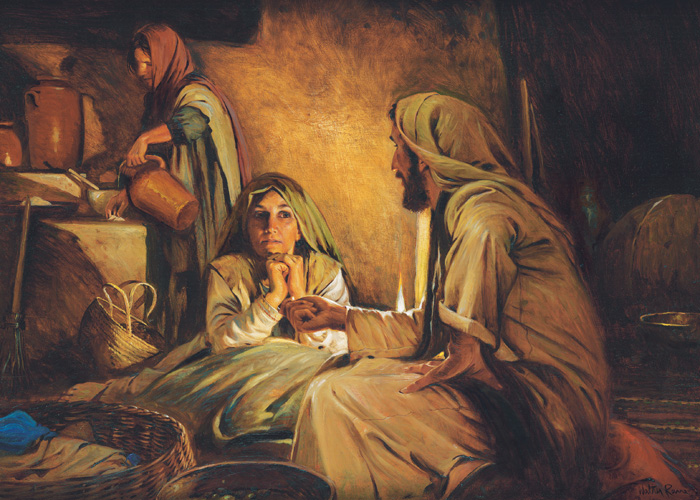 |
| Mary listens while Martha works |
A
major shift in Luke’s Gospel occurs at Luke 9:51 (and goes to Luke 18:14), as
Jesus turns his attention from ministry in Galilee to a resolute focus towards
Jerusalem and his coming suffering. Despite opposition (Luke 9:51-56), Jesus
calls for personal sacrifice, even of family responsibilities, in order to
concentrate completely on serving the Lord (Luke 9:57-62). Accordingly as Jesus
moves toward Judea and Jerusalem, he sends 72 disciples ahead with a warning
that God’s Kingdom is near (Luke 10:1-12). Despite his great sadness toward
those who have rejected it (Luke 10:13-16), Jesus focuses his joy over those
who have received salvation (Luke 10:17-24). Questioned by an expert in Torah,
Jesus tells the story of the Good Samaritan to show the full extent of the
Law’s demands of the believer. Authentic spiritual life is defined by love for
God and others (Luke 10:25-37). Authentic spiritual life is also defined by the
priority of God’s Presence (Luke 10:38-42) and prayer (Luke 11:1-13).

Key Truth: Luke
wrote Luke 10:38-11:13 to teach believers the
importance of the priority of His Presence.
Key Application: Today I
want to show you what God’s Word says about your relationship with Jesus.
Pray and Read:
Luke 10:38-11:13
Sermon Points
1. Jesus
calls you to the priority of His Presence (Luke 10:38-42)
Thursday, February 23, 2012
Flexible Prayer Plan
Here is a flexible prayer framework
to help you hear God’s gentle prompting in prayer. Use it if it serves you or
change it to suit you.
Wednesday, February 01, 2012
Radical Desperation for His Presence

Paul gives us two conditions for intercession in the church: holy
hands, and no anger or dissension (1 Tim 2:8). Getting right before God, and
then getting right with each other. God wants all kinds of prayers, requests,
intercession, and thanksgiving (1 Tim 2:1). He enjoys common, simple prayers. The
Lord enjoys radical, passionate prayers. We pray best when we admit our
weakness and ask the Holy Spirit to take control of our prayer (Rom 8:26-27).
Have you ever been at a place where you were so weak that you had no other option than the Lord? If you haven’t been there, your time is coming. That’s not to scare you, but to warn you that if you want to walk with the Lord, you need to know that He will train you to trust Him. He will lead you into the valley of the shadow of death so that you can learn to know that He is always with you, so that His rod and His staff may comfort you (Psalm 23:4).
Thursday, January 19, 2012
Comfort in His Presence
In this old fallen world, life deals us blows. Perhaps the
blow is a broken marriage. Perhaps it is bad news at the doctor’s office (Psalm
41:1-3). Perhaps it is the loss of a dearly loved one. Perhaps it is a layoff.
Perhaps it is an errant child or grandchild. Perhaps it is a lie. Perhaps it is
the sheer crushing strength of stress. Perhaps it is the ache of a violation years
ago. Perhaps it is betrayal or rejection. Perhaps it is the devouring beast
called depression. Perhaps it is being blindsided by your best friend. Perhaps
it is the deep water of financial insecurity or unspeakable loss. Perhaps hope
deferred has made your heart sick. Or discouragement, disillusionment, despair,
depression, deceit, delusion, dead works, distrust, disgrace, disappointment,
even death.
Tuesday, January 10, 2012

Sunday, January 01, 2012
Luke 2:21-40 - The Presentation of Jesus
 |
| Presentation in the Temple (Philippe de Champaigne, 1648) |
Luke
begins his gospel in the Temple with an unbelieving priest, Zechariah, and he
ends the birth narrative at the Temple with a believing man, woman, and the boy
Jesus. Joseph and Mary are careful to keep the requirements of the Law. His
circumcision was apparently in Bethlehem but for the purification they had to
travel to the Temple in Jerusalem. There they are greeted by two remarkable
individuals, both aged and devout, Simeon and Anna, who speak about the future
of the child.
Key Truth: Luke
wrote Luke 2:21-40 to teach believers how the Presentation of Jesus is
a call to consecration for his people, a call to the Glory of the Lord among
the nations, and a call to worshiping intercession before the Lord of the
nations.
Key Application: Today I
want to show you what God’s Word says about God’s call to us in the New Year.
Key Verse: Luke 2:31-32
Pray and Read:
Luke 2:21-40
Sermon Points:
In this New Year we have a
1. Call
to Consecration to the Lord among His people (Luke 2:21-24)
2. Call
to Glory of the Lord among the nations (Luke 2:25-35)
3. Call
to Prayer before the Lord of the nations (Luke 2:36-40)
Thursday, December 15, 2011
Psalm 9 - My Part and God's Part

Think about the challenges that have been laid before you. Family challenges. Financial challenges. Workplace challenges. Health challenges. Relationship challenges. And then there are the challenges that you have brought on yourself. Did you know that the Lord is sovereign, too, over those challenges, all those challenges?
If He is sovereign, then it means He is in charge. If He is in charge, then that means He has taken responsibility for them. If He has taken responsibility for them, then He has adequate resources to take up and handle those challenges. Now the question is, do you trust Him to take responsibility for your challenges? Or would you rather handle them on your own?
Thursday, October 06, 2011
House of Prayer or Den of Thieves?
 |
| Luca Giordano, Christ Cleansing the Temple |
What is hindering you from completely pursuing an intimate relationship with Christ? Are your attentions distracted? Is it busyness? Is it religious activities? Do you have a divided heart? What are you doing that is crowding the Lord out of your life (Jer. 7:13)? Why are you doing it? What would you do differently if you knew Jesus was in the house? Do you run around like Martha in a hectic blur and find yourself farther and farther behind? What did you choose yesterday that cannot be taken away? (Luke 10:38-41. Notice Jesus’ teaching on prayer immediately follows in Luke 11).
Thursday, September 29, 2011
Consumed by Him by consuming Him

Where is the appetite for Christ among those who name Him as Lord?
Thursday, September 08, 2011
Nothing but the Blood of Jesus
Revelation 12:11
From the book of Deuteronomy we hear the truth, “The life is in the blood” (Deut. 12:23). Across the centuries of the church, we have held precious the songs about the Blood of Jesus. The Blood of Jesus stands as evidence of how much we are loved. When we truly come to grips with our unworthiness to take the sinless Sacrifice of our Lord as our atonement, we are overcome as we sing with the hymn writer, “O precious is the flow that makes me white as snow.”
What His Blood Does
- By His Blood Jesus atoned for my sin (Lev 17:11; Rom 3:25; 1 John 4:10)
- By His Blood, I am justified, acquitted of sin and guilt, and exonerated of God’s wrath and judgment (Rom 5:9)
- By His Blood I am forgiven once for all. My guilt is legally remitted (Heb 9:22, 25)
- By His Blood even our sins committed in ignorance are availed (Heb 9:7)
- By His Blood I am redeemed from the empty way of life handed down to me from my forefathers (1 Peter 1:18-19)
- By His Blood sprinkled in the Most Holy Place, atonement is made for us (Lev 16:27)
- By His Blood our redemption and forgiveness were purchased from sin and death by God’s grace, and I forever belong to Him (Eph 1:7; 2:13; Matt 26:28; Col 1:14; Rev 5:9; Acts 20:28)
- By His Blood we have a testimony that the death angel has passed over us (Exod. 12:13, 23)
- By His Blood we have abundant grace and peace through its cleansing and sanctifying work (1 Peter 1:2; Heb 13:12)
- By His Blood I now have full salvation and reconciliation with joy in Him (Rom 5:10-11)
- By His Blood we are reconciled to God as all His righteous requirements of us are satisfied (Col 1:20)
- By His Blood I have right standing before God as a priest in His Kingdom (1 John 1:7; Rev 1:5-6; 7:14)
- By His Blood we have an unassailable position in our salvation (1 Cor.10:16; John 10:28-29)
- By His Blood I stand clean before God and thankful for his irrevocable covenant (Heb 9:14-15, 24; Luke 22:20; 1 Cor. 11:25)
- By His Blood the eternal covenant of Jesus binds to me all the transforming power and pleasure of God (Heb 13:20-21)
- By His Blood we have confidence to enter in and draw near to God in full assurance that there is no ground of accusation (Heb. 10:19-22; Eph 2:13)
- By His Blood we have overcoming power over the enemy, and it prevails over the gates of hell (Rev 12:11; Matt 16:18)
- By His Blood we have power over the sins, habits, and hurts of this life (Zech 9:11-12)
- By His Blood Jesus destroyed the works of the devil, and it stands effective between me and the enemy (Heb 2:14)
- By His Blood we celebrate our Redeemer (Matt. 26:28)
Overcome with accusations? Stand on Heb. 9:14; Rev. 12:10-11. Overwhelmed at the warfare? Pray Rev 12:11; 19:11-16. Overtaken by sin and temptation? Run to Psalm 40:12-13; 1 John 1:9. Find your power and your safety in the Blood of the Lamb! It is the confession of overcomers (Rev. 12:11).
Wesley Duewel, the writer on prayer, says the Blood is “the greatest, most powerful, most unanswerable plea of all. There is no more prevailing argument we can bring before God than the sufferings, blood, and death of His Son. We have no merit of our own. We do not prevail in prayer by techniques or past experience. It is only through the blood of Jesus."
Pray till you have assurance of God’s will. Pray till you have been given by the Spirit a vision of what God longs to do, needs to do, wants to do. Pray till you are gripped by the authority of the name of Jesus. Then [call on the covenantal power of] the blood of Jesus. Call on them [the Name and the Blood], stake your all on them, and use them to the glory of God and the routing of Satan.” [1]
Read the truth above. Pray the truths above. Declare the freedom of the truth above.
“There is power, power, wonder-working power in the precious blood of the Lamb.”
Adapted from
Sylvia Gunter, Prayer Essentials for Living in His Presence vol. 1
(Birmingham, AL: The Father's Business, 2000).
[1]Wesley Duewel, Mighty Prevailing Prayer (Grand Rapids: Francis Asbury Press, 1990), 307.
Wednesday, August 10, 2011
The Church Ordinance of the Lord's Supper

The Bible calls the Lord’s Supper by several terms: the breaking of bread (Acts 2:42), the Lord’s Table (1 Cor. 10:21), Communion (1 Cor. 10:16), the blessing (1 Cor. 10:16), the Lord’s Supper (1 Cor. 11:20, here it is a complete meal), the Thanksgiving or Eucharist (1 Cor. 11:24). The Catholic term, mass, is not found in Scripture but comes from a Latin verb mittere (to send) and was used as early as the late 4th century by Ambrose.
Jesus instituted the Lord’s Supper (Matt. 26:17-30; Mark 14:12-26; Luke 22:7-30; 1 Cor. 11:17-34; also Acts 2:42; 1 Cor. 10:14-22) in the midst of the observance of Passover (Exodus 12) with his disciples. The Lord’s Supper is a covenant meal (Luke 22:20: “this cup is the new covenant”), and Christ is our Passover Lamb (1 Cor. 5:7).
The words of institution “This is My body,” in Latin, “Hoc est corpus meum,” (the magic words “hocus pocus”), have caused a lot of controversy. There are four interpretations.
- TRANSUBSTANTIATION – (Catholic view) When a properly ordained priest lifts the elements (host), and repeats “hoc est corpus meum,” a miracle occurs. While they appear as bread and wine, the elements are literally become in substance (transubstantiated) into Christ’s body and blood. The celebration of mass thus involves a recrucifixion of Christ, granting forgiveness for venial sins, increases grace, preserves from mortal sin, and gives hope of salvation. How did they come to this? Gradually over the centuries, ideas of grace through the sacraments, the power of the ordained clergy, and a desire for magic in religion led to the official adoption of this view at the Fourth Lateran Council (1215). Unfortunately this position is defective theologically (contradicting Christ’s once-for-all sacrifice), exegetically (the literal interpretation of John 6:32-39 is unnatural and forced – Jesus literally distributing his own body), ecclesiologically (the effectiveness of the priest’s ordination is more important than Christ’s blessing on those who take it by faith), and philosophically (using Aristotelian categories that are foreign to Scripture). That’s good reason why the Reformers opposed it as blasphemous and a chief error of the Roman Catholic Church.
- CONSUBSTANTIATION – (Lutheran view). While Martin Luther denied the Roman Catholic view, he believed that faith was necessary for a blessing in the Supper, and he affirmed the real, bodily presence of Christ by Christ’s power “in, with, and under” the elements. Christ comes clothed in bread and wine. While there are some philosophical ideas foreign to Scripture, the larger problem is exegetical. Perhaps because of his Catholic heritage so dear to him, Luther could not accept an interpretation that was less than totally literal. For him Christ was omnipresent everywhere the Supper was being conducted. He and Ulrich Zwingli could not agree, and at the famous colloquy of 1529, he demanded that “is” means “is.” It maddened him that Zwingli said “is” means “signifies” in many places in Scripture.
- SPIRITUAL PRESENCE -- (Calvin, Presbyterian view). “This is my body” means that Christ promises his spiritual presence at the Supper, but not his bodily presence in the elements. The elements are important because they are God’s ordained signs, but their importance is in what they signify. The English Baptists who were Calvinist held to this view as well in their 2nd London Confession.
- MEMORIAL – (Zwingli, Anabaptist, most Baptists). The words “this is my body” are understood as “this signifies my body.” While Zwingli believed Christ was spiritually present with believers when they gather in his name, the Lord’s Supper was a memorial meal (“This do in remembrance of Me.”)

Thursday, August 04, 2011
Ten symptoms your Christianity is too comfortable
1. You are not attending church with a high level of expectancy.
 |
| It is not about you. It's about Him. |
2. You no longer seem to be concerned about the spiritual condition of neighbors, family members, or your co-workers.
3. You haven’t had a spiritual conversation with a non-Christian in a long time. You can't even think how you'd manage one.
4. The Bible seems lifeless to you. It’s like a history book with so many unpronounceable words.
5. Your happiness on Sunday mornings is more important to you than what it takes to reach the unreached nations. As long as you get your parking spot, your seat, and hear the music you like, everything’s fine.
6. The plight of the poor doesn’t concern you. Images of overseas suffering do not move you to action.
7. The idea of worship seems a boring waste of time. You don't "get anything out of it."
8. You do not give your financial resources sacrificially. You kind of resent it, actually.
9. Your prayers don’t seem to be making it past the ceiling. There's this faint frustration when you try to pray.
10. It doesn’t even dawn on you that God could do something incredibly radical in your life at any moment today. It’s not even on your radar.
The old-timers have a term for you: Back-slidden. You need revival.
It is not all about your comfort and entertainment. It is about the Glory of the Holy One of Israel.
So what do you do about it? Do the things you know to do.
Confess to the Lord and repent of your dead, wooden Christianity. Open the Word of God and ask the Lord to renew your spirit through the ministry of His Spirit.
Psalm 51 is a good place to start. Read and pray through that one.
Chart your progress by the depth and thankfulness of your tears.
Source: Brian Dodd, a church leadership consultant, suggested this helpful list over at churchleaders.com. I made a few additions.

Friday, July 29, 2011
The Church’s Ministry of Worship

Worship of Father, Son, and Holy Spirit is a third important part of what the Church is and does. In Acts 2, authentic worship is marked by two things: reverential awe before a holy God (“then fear came upon every soul and many signs and wonders were done,” Acts 2:43; worship in Spirit, John 4:24) and joyful praise (“they ate their food with gladness and simplicity of heart,” Acts 2:46; worship in truth, John 4:24). Biblical worship is God exalting, Christ-centered, and Holy Spirit empowered. Worship also involves people, both believers and non-believers; therefore, planning well-rounded worship services every week is a demanding task. Worship should include several dimensions.
1. The Glory dimension (Isaiah 42:12; Rev 5:13). We ascribe to God his worth and glory through songs that exalt God, through remembering his work through the Lord’s Supper, through reading his Word, through prayers which praise his name, seek his face, ask his blessing, and intercede on others’ behalf, through giving our offerings of time and treasure, and through obedience to him through responding to his invitation.
2. The Teaching dimension (Colossians 3:16a). We worship through reading, preaching, and teaching the Word of God, through songs sung to one another (Ephesians 5:19) and the Lord.
3. The Encouragement dimension (1 Thess 5:14). Worship should edify, exhort, rebuke, and encourage us to strengthen our walk with Christ, to be obedient to his call, and to give of ourselves in time and monies to serve and build up others in tangible ways.
4. The Evangelism dimension (1 Peter 2:9). Worship involves responding in obedience to the invitation of the gospel. While every sermon text may not be strongly focused on a gospel presentation each week, there should be the opportunity for individuals to respond to the invitation of the Good News of Jesus Christ at every practical opportunity.
Elements of Worship
The New Testament provides no set order of worship. That has allowed for cultural and preferential variety in different times and places, but there also seems to be continuity across history and cultures. The early church was ethnically Jewish, and therefore it included corporate worship patterns from Judaism including songs of praise, prayers, and the public reading of Scripture. Justin Martyr’s (110-165 A.D.) First Apology is the oldest record outside of the Bible of the ancient Christian order and time of congregational worship.
'On the day called Sunday, all who live in cities or in the country gather together to one place, and the memoirs of the apostles or the writings of the prophets are read, as long as time permits; then when the reader has ceased, the president verbally instructs, and exhorts to the imitation of these good things. Then we all rise together and pray, and, as we before said, when our prayer is ended, bread and wine and water are brought, and the president in like manner offers prayers and thanksgivings, according to his ability, and the people assent, saying Amen; and there is a distribution to each, and a participation of that over which thanks have been given, and to those who are absent a portion is sent by the deacons. And they who are well to do, and willing, give what each thinks fit; and what is collected is deposited with the president, who succors [give assistance to] the orphans and widows, and those who, through sickness or any other cause are in want, and those who are in bonds, and the strangers sojourning among us, and in a word takes care of all who are in need. But Sunday is the day on which we all hold our common assembly, because it is the first day on which God, having wrought a change in the darkness and matter, made the world; and Jesus Christ our Savior on the same day rose from the dead.'
One new element drawn from the Passover meal which the Lord Jesus instituted was the Lord’s Supper. Within a few centuries it became the central part of worship up to the Reformation (16th Century) when preaching took center stage. The Lord’s Supper is the only act of worship which has specific instructions (1 Cor. 11:23-32), and both the Supper and baptism are acts of worshiped that should be practiced regularly.
Music in Worship. (Colossians 3:16b; Ephesians 5:19). Before the Reformation, the only singing in the Catholic Church that was permitted was of choirs. The people were not allowed to sing. After the Reformation, singing was a hotly debated topic among Protestants. The disagreement was whether to sing the Psalms as the Anglican Church continues to do today or to sing the newer hymns by Isaac Watts. The influential British Baptist Benjamin Keach, who pastored the church later led by Charles Spurgeon, argued strongly for hymn singing in the late 1600s, and it has become central in worship now for centuries. Then later there were disagreements over whether it was OK to bring worldly instruments from the saloons into the church and play them, what some people called the devil’s instruments – organs and pianos. Today the hymns are fighting the contemporary worship songs, but the lesson is that musical styles change while the message and the Person worshiped remains the same. A good criteria for musical style is Philippians 4:8.
Public Reading of Scripture (1 Timothy 4:13). Paul encouraged Timothy to make the public reading of Scripture an important part of worship. Alas, in many of our churches the reading of Scripture has become as haphazard and unthought-of as public prayer, and we have suffered for it. Reading of Scripture should occupy a larger and more intentional part of the worship of churches that believe in the inerrancy of Scripture. Our worship in song should be punctuated with Scripture reading as well. Our public prayer should be done in better ways that reflect Scripture.
The Regulative Principle or the Normative Principle? What about skits, drama, artistic dance, or video clips in worship? Are they appropriate? Some say they are not on the basis of the regulative principle of Scripture. This idea comes from the Westminster Confession and thus the Second London/Philadelphia Confession that God should not be worshiped in any way “not prescribed in the Holy Scriptures.” Mark Dever recommends that we could adopt the following worship grid: read the Bible, preach the Bible, pray the Bible, sing the Bible, and see the Bible (in the ordinances) – that everything in worship be guided by biblical principles.
Others see by way of the normative principle of Scripture: whatever is not prohibited is acceptable, i.e., the mature use of common sense (Galatians 5:1). Should we worship on Sunday morning or Sunday evening? Does the Bible say we should not meet to pray on Wednesday nights? Does the Bible say we should not build a gymnasium and host evangelistic basketball leagues? Does the Bible say we should not have video projection? Does the Bible say we should not have Sunday School? Does the Bible say we should not have mission boards?
I am endebted to John Hammet at Southeastern Seminary for much of this material.

Subscribe to:
Posts (Atom)