Showing posts with label Matthew. Show all posts

Sunday, December 23, 2012

Matthew 2:1-12 - The Worship of the Wise Men

English: Adoration of the Wise Men by Murillo
Adoration of the Wise Men by Murillo (Wikipedia)
When we think of Christmas, we think of gifts.  But now gift buying has gone to a whole new level of craziness.  All I have to do is say two words: “Black Friday.”  Did you join the madness?  Gifts are a now part of the DNA of Christmas. There is a line from Little Women that says: “Christmas won't be Christmas without any presents.”  And that is true, isn’t it?  If you are not in the Christmas spirit, you really should come to our house – five little ones 7 and under – the air is electric with excitement, awash in adrenaline, on edge with anticipation. Christmas is almost here! We get a daily count down of days until Christmas every day at lunchtime.

Today we will talk about some gifts given to the Christ Child by the Wise Men, or the Magi. The Wise Men were not present at the birth of Jesus, in spite of the fact that many Christmas plays and manger scenes have them there. They came a number of months or even up to two years later. We know based on the Greek word for "child" in Matt. 2:8-9 and the time it would take to travel 900 miles from Persia to Jerusalem.  We know that they brought at least 3 kinds of gifts: gold, frankincense, and myrrh.  We know what they brought & why they came: to worship the new King. Today we want to talk about the worship of the Wise Men.

Key Truth: Matthew wrote Matthew 2:1-12 to encourage people through the example of the Magi to come to worship, seek to worship, and give to worship the newborn King. 
Key Application: Today I want to show you what God’s Word says about worshiping the King.
Pray and Read:  Matthew 2:1-12

Sunday, December 16, 2012

Matthew 1:1-17 - The Ancestry of Jesus

Matthew Evangelist. The text also says - Abrah...
Matthew Evangelist. The text also says - Abraham and David (Photo credit: Wikipedia)
Key Truth: Matthew wrote Matthew 1:1-17 to teach believers that the ancestry of Jesus is important to identify him as the Messiah.

Key Application: Today I want to show you what God’s Word says about Jesus’ ancestry.

Key Verse: Matt 1:1
Pray and Read:  Matthew 1:1-17

Wednesday, February 15, 2012

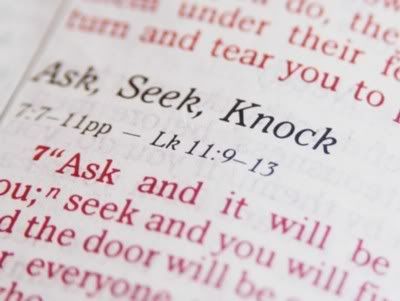
Ask, Seek, Knock

Matthew 7:7-8; Luke 11:9-10

Ask with humility and consciousness of need. Jesus tells us to ask him in prayer. Here the verb aiteō (αιτέω, ask) has the meaning of asking for something.[1] When one asks in Christ, we ask with family or redemptive rights. In prayer, we ask God with humility because we have confidence in his promises. His promises are based on His character. We come to the Lord as dependent children, needing Him and His love and the basics of life.

Thursday, December 01, 2011

Pray the Beatitudes

Site of Sermon on the Mount
Matthew 5:1-10

In the Abrahamic Covenant (Genesis 12:1-3), the Lord promised Abraham He would bless him and make him a blessing to the nations. The New Covenant in Jesus’ blood incorporated the Abrahamic Blessing yet also initiated a radical new order of blessing and blessedness. 

The Beatitudes are the first words of the first teaching (torah) of the Messiah in the first book of the New Testament. These words of blessing are the first royal pronouncement of this King in Matthew. The Great Commission is the final royal command to be a blessing to the nations (Matt. 28:18-20). In the Beatitudes our Lord goes up on a mountain (Psalm 24:3; Heb 12:18, 22) and sits down (Heb 1:3-4) to teach with royal authority and inaugurates the new way of the Kingdom of Messiah which we are called to seek above all else (Matt. 6:33).  The Beatitudes are Kingdom promises of blessing conditional on obedience to the King. When we walk in obedience to our King, we are promised royal blessedness as He molds us into the character of the Son. 

Pray the Beatitudes by following the link below:

Thursday, October 06, 2011

House of Prayer or Den of Thieves?

Luca Giordano, Christ Cleansing the Temple
Matthew 21:12-17:Jesus intends for His House to be a house of prayer (Isaiah 56:7). But there are defilers in the Temple, “but you are making it a den of robbers” (Jeremiah 7:11). As God watches your life, watches us, what does He see (Jer. 7:11)?

What is hindering you from completely pursuing an intimate relationship with Christ? Are your attentions distracted? Is it busyness? Is it religious activities? Do you have a divided heart? What are you doing that is crowding the Lord out of your life (Jer. 7:13)? Why are you doing it? What would you do differently if you knew Jesus was in the house? Do you run around like Martha in a hectic blur and find yourself farther and farther behind? What did you choose yesterday that cannot be taken away? (Luke 10:38-41. Notice Jesus’ teaching on prayer immediately follows in Luke 11).

Thursday, September 22, 2011

Peace in His Presence

"Take courage! Don't be afraid!"
Everybody is looking for peace. One time Jesus spoke to the storm and stilled it (Matt 8:23-27), but another time Jesus spoke in the midst of a storm (Matt 14:22-33) to calm his friends’ fears, “I’m here. Take courage. Don’t be afraid” (Matt. 14:27). Then he commanded his friend and disciple Peter to walk to Him in the middle of the storm (Matt 14:28-29). It was a test of his faith (Matt 14:30-31).  

The point? Jesus removes some storms, but when you are able to handle it, he will not remove some storms, even the storms of his friends. He chooses instead to be present with us in the midst. He walks right into them, in fact to demonstrate his greater glory. Even in the storm of Matthew 14, when the test was over, the wind ceased (Matt 14:32) and the result was worship (Matt 14:33).

Thursday, April 21, 2011

Scripture for Thursday of Holy Week

(Maundy) Thursday, Passover begins at sundown, April 14, AD 29
 
Preparation for Passover: Matthew 26:17-29; Mark 14:12-16; Luke 22:7-13
 
Passover (6:00-11:30pm):
  • Sop - Betrayer Identified: Matthew 26:20-25; Mark 14:17-21; John 13:21-35
  • Afikomen and Third Cup – The Lord’s Last Supper: Matthew 26:26-29; Mark 14:22-25; Luke 22:14-23; 1 Corinthians 11-23-26
  • Who is greatest? Luke 22:24-30
  • Jesus Washes Disciples’ Feet: John 13:1-20
  • Peter’s denial foretold: Matthew 26:31-35; Mark 14:27-31; Luke 22:31-38; John 13:36-38
Gethsemane (11:30pm – 1:00am): Matthew 26:30; Mark 14:26; John 18:1; Matthew 26:36-46; Mark 14:32-42; Luke 22:39-46

Jesus Betrayed, Arrested (1:00 – 1:30am): Matthew 26:47-56; Mark 14:43-52; Luke 22:47-53; John 18:2-11

Jesus brought to Annas, High Priest, sent to Caiaphas: John 18:12-14, 24

Wednesday, April 20, 2011

Scripture for Wednesday of Holy Week

Wednesday, April 13, AD 29
 
Gentiles seek Christ; Jews reject Him: John 12:20-50

Judas Agrees to betray Jesus: Matthew 26:14-16; Mark 14:10-11; Luke 22:3-6 

Jesus Anointed: Matthew 26:6-13; Mark 14:3-9; John 12:1-11


Sunday, April 11, 2010

Matthew 28:16-20 - The Cooperative Commission

Request a free DVD or CD of this message from genebrooks@yahoo.com. Include the sermon title and your mailing address. 

Pray and Read: Matthew 28:16-20

Contextual Notes:
In Matthew 28, we find an important post-Resurrection appearance of Jesus. The women offered a true report (28:1-10) of the Resurrection of Jesus Christ. The guards offered a false report (28:11-15). Matthew now says that we, like the women, must offer a true report and resist the temptations that the guards fell for like money and protection.

Note that they go up on a mountain. Matthew places Jesus on a mountain for the Sermon on the Mount (Jesus’ interpretation of the Torah), his Transfiguration (fullness of His Manhood), and the Great Commission (here). Why does Matthew do that? He is showing Jesus as not one who is the law-giver as Moses, but the Law-Maker, as a man he is one greater than Moses. He does not have a shining face on the mountain, but he is a shining person.

Here, Jesus is also greater than Moses in that he gave four sermons in Deuteronomy to prepare the people to cross into the Promised Land and then died on Mount Nebo. Jesus as a Resurrected King gives four commands on the mountain in Galilee to prepare his disciples for Pentecost and the beginning of the Church. Moses was not able to accompany them into the Promised Land. Jesus says he is with us always, even until the end of the age.

Sermon Points:
1. Go to all ethnic groups (Matt. 28:19)
2. Make disciples of all ethnic groups (Matt. 28:19)
3. Plant churches among all ethnic groups (Matt. 28:19)
4. Trust Christ’s presence with you (Matt. 28:20)

Exposition:
This passage is broken into an imperative and three participles with a final divine promise/fact.

1. GO TO ALL ETHNIC GROUPS (Matt. 28:19)
a. The participle not only assumes that we are going, but the grammatical construction of placing a participle before an imperative in the Greek language gives the force of a command to the participle. So “Going” becomes “GO!” If true, and we are waiting for God to call us to go, should we not instead be waiting for God to call us to stay?

b. Assumes we are crossing cultural barriers. The Jordan we cross today is cultural barriers to the gospel, whether to another generation, another racial group, another continent.

c. APPLICATION: Are you going to all the ethnic groups? Are you praying for salvation for those who are lost among us? Are you looking for opportunities to share your faith with those who are different from you? Or do you avoid them in the doctor’s office or in line at the DMV or on your job? The question is not whether you might be called to go to the nations but rather what prevents you from going? If you cannot go, can you give of your resources to the Cooperative Program to help those of us who are called? If you cannot give, can you support those who are going through ministries like the Women’s Missionary Union, Baptist Men, Royal Ambassadors, or Girls in Action? If you cannot support, will you pray for those who are going? This Great Commission is a cooperative commission in which everyone has a responsibility and a privilege of service. In what way are you going to the nations?

2. MAKE DISCIPLES OF ALL ETHNIC GROUPS (Matt. 28:19)
a. Disciplize is the word that Matthew coins. Not make converts, not proselytize, but make disciples.
b. Of all nations – panta ta ethne -- not just people like us. We are called to cross the barriers. As long as there are ethno-linguistic groups without a witness, without a church in their language and culture on the planet, the Great Commission has not been fulfilled. When this occurs, 24:14 tells us that the end will come.
c. William Carey: Moderator of Baptist association meeting said to him: If God wants us to reach the heathen, he will do it without you or me.

d. APPLICATION: Are you a disciple of Christ? Are you growing in your relationship with Jesus? If not, why not? Are you in a disciple-making relationship? Are you mentoring someone or being discipled? Are you in a Bible study that has relationships with other believers which help you grow in Christ?

e. Are you looking for opportunities to make disciples of those of other nations who are among us today? Is there a call on your life to make disciples of other nations? Are you pursuing that call? Go on a short-term mission trip either in the States or internationally. Would you be willing to help your pastor organize a mission trip next year to Liberia, West Africa, where we can work with burgeoning church planting movement with friends of Amanda’s and mine?

f. If you are not tithing, begin to do so and also discover the blessings of giving beyond the tithe. Encourage your church to increase its participation in the Cooperative Program.

3. PLANT CHURCHES AMONG ALL PEOPLE GROUPS (Matt. 28:19)
a. Baptizing: Step of obedience to Christ and incorporation into the local church. We have lost this ordinance’s importance. In some countries like parts of India or Pakistan, to be baptized publicly is to invite poisoning from family members, or assassination by radical Hindus or Muslims.

b. It is a Believer’s baptism done after submitting to Christ.
i. Prophetic picture of death, burial, resurrection – Romans 6:4-6. As we baptize, we picture the Death, Burial, and Resurrection of Christ and our participation in that with him. baptizo means immerse or sink. That is why we immerse and don’t sprinkle.

ii. Trinitarian baptism -- We baptize in the name of the Father, Son, and Holy Spirit. This passage places Jesus on the same level of divinity as the Holy Spirit and the Father.
iii. Not baptismal regeneration – You cannot be saved by baptism. Christ is the savior, not an act. If any act has to be performed before you are saved, then you are earning your salvation, baptism included. Regarding the act of baptism as necessary to salvation offends the work of Christ on the cross.
iv. Not infant baptism. If Catholic background, it does not remove original sin in a child. Only Christ removes original sin. If Presbyterian or Methodist, that was a dedication by your parents of you to the Lord. It did not signify salvation but only that you were in the covenant of faith, not that you had made a decision to follow Christ. Believers baptism does not discount or offend what your parents did. If you have not been baptized as a believer, you need to follow Christ in obedience to him.

c. Teaching: Not just preaching. Teaching the full counsel of God “whatsoever things I have commanded you.” Helping others, your children, your coworkers, those of other ethnic groups, learn the Bible, to know its precepts, its flow, its message, its Lord.

d. APPLICATION: Are you in the Word yourself? Or is all the Bible you get these 30 minutes on Sunday morning and what you hear on Christian TV or radio Bible teaching. Read the Word. Ask the Holy Spirit to teach you. Buy Bible reference books and use them to study the word. Feast on him. Learn from others’ lives and the Word.

e. One of the visions I would like to see happen in this church is to plant another church of a different ethnic group, such as Latino or African-American. Has the Lord burdened you with that vision?

4. TRUST CHRIST’S PRESENCE WITH YOU AMONG THE PEOPLE GROUPS (Matt. 28:20)
a. His omnipresence and manifest presence with us in our mission is not just a promise. It is a divine fact.

b. ILLUSTRATION: G. Campbell Morgan, that great expositor of Scripture, was reading this passage to a shut in one day on a visit. He said, “This is a great promise.” She looked out of the side of her eye with a smile, “No sir, that is a fact.”

Cooperative Program Emphasis
Since its inception in 1845, the Southern Baptist Convention (SBC) has always had one mission—the Great Commission (Matt. 28:19-20). To fulfill its assigned part of this divine mandate, each SBC entity made special offering appeals to the churches. This method was referred to as the “societal” approach to missions and resulted in severe financial deficits, competition among entities, overlapping pledge campaigns, and frequent emergency appeals which greatly hampered the expanding ministry opportunities God was giving Southern Baptists.

In 1919, the leaders of the SBC proposed the 75 Million Campaign, a five-year pledge campaign that, for the first time, included everything—the missions and ministries of all the state conventions as well as that of the Southern Baptist Convention. Banking on that campaign, some Southern Baptist entities took out loans to cover operating costs until pledges or special offerings were received. But the Campaign fell short of its goals, and many agencies found themselves overextended with no way to pay their bills.

In the midst of that embarrassment, a God-given partnership of missions support was conceived—The Cooperative Program. Since its launch in 1925, the effectiveness of CP has been dependent upon individuals, churches, state conventions, and SBC entities cooperating, working toward a common goal of sharing the gospel with every person on the planet.

How it works: Simply put, it begins with you. You give yourself first to God (2 Cor. 5:8). Out of gratitude and obedience to God for what He has done for you, you commit to give back to Him, through your church, a portion of what He provides. This is commonly called a tithe and represents ten percent of your income (Lev. 27:30, Mal. 3:10).

Your church decides the next step. Every year your church prayerfully decides how much of its undesignated gifts will be committed to reaching people in your state and around the world through Cooperative Program (CP) Missions. This amount is then forwarded to our state Baptist convention.
During the annual meeting of your state convention, messengers from Southern Baptist churches across the state decide what percentage of Cooperative Program gifts stays in the state to support local missions and what percentage will be forwarded to the SBC for North American and international missions.
At the SBC Annual Meeting, messengers from across the country decide how the gifts received from the states will be distributed among SBC entities. These gifts are used by Southern Baptist entities to send and support missionaries, train pastors, missionaries, and other ministry leaders; provide relief for retired ministers and widows; and address social, moral, and ethical concerns relating to our faith and families.

The bottom line – people around the world hear the gospel and receive Christ.

Note: Your local Southern Baptist association does not receive CP gifts directly. It ministers through gifts received directly from churches and often receives CP gifts indirectly in the form of support from state conventions and the North American Mission Board.

What it does: At the national level, Southern Baptists support over 5,000 missionaries who are engaging more than 1,193 different people groups around the world through the International Mission Board.
In 2008, over 1,578 new churches were planted through the efforts of more than 5,611 North American missionaries working with your North American Mission Board and individual state conventions.

Working together, Southern Baptists saw 908,165 new believers baptized in 2008! One baptism every 38 seconds. Through the Cooperative Program, Southern Baptists plant 53 Bible-based churches every day. That’s 19,401 a year.

Through the Cooperative Program, Southern Baptists are the third largest disaster relief provider in the world.

Six Southern Baptist seminaries (Southern, Southeastern, Midwestern, Southwestern, Golden Gate, and New Orleans) educate in excess of 16,000 pastors, missionaries, and future church leaders each year.

The Ethics & Religious Liberty Commission is dedicated to addressing social, moral, and ethical concerns, with particular attention to their impact on American families and their faith. They also provide print resources that offer scriptural responses to the moral and ethical problems of our culture.
Your prayers and support also undergird the work of GuideStone Financial Resources, the Historical Library and Archives, and the Southern Baptist Foundation.

Although they receive no CP Missions support, LifeWay Christian Resources and the Woman’s Missionary Union (WMU) actively promote CP Missions in publications and missions resources.

Churches in North Carolina work together through our Baptist State Convention to support a wide array of ministries and missions including: evangelism efforts, children’s homes, volunteer missions, missions education, church planting, colleges and universities, collegiate ministries, camps, and much more.

Let’s look at a powerpoint presentation about what NC Baptists are doing in their obedience to the Great Commission.

Invitation:
Salvation
Church membership
Call to missions or ministry

Sunday, April 04, 2010

Matthew 22:1-14 - You're Invited!

Opening thought:  Sir Leonard Wood once visited the King of France and the king was so pleased with him he was invited for dinner the next day. Sir Leonard went to the palace and the king met him in one of the halls said, “Why Sir Leonard, I did not expect to see you. How is it you are here?” “Did not your majesty invite me to dine with you?” said the astonished guest. “Yes,” replied the king, “but you did not answer my invitation.” Then Sir Leonard Wood uttered one the best sentences of his life: “A king’s invitation is never to be answered, but to be obeyed.”

Pray and Read: Matthew 22:1-14

Contextual Notes: 
Matthew's goal in writing his gospel was to demonstrate that Jesus is the Messiah King that the entire Bible up to that point (the Old Testament) predicted. This parable is about a king and his son’s wedding banquet.

This parable was given during Jesus’ last week on earth, his Passion Week. Since it follows the triumphant entry and precedes Jesus’ teaching on the end times (Matthew 24, 25) on Wednesday of the Passion Week, chronology experts put this parable on Wednesday morning (along with all of Matthew 21:19b through 23:37-39).

There is a vital connection between this parable and the former as seen in the linking of Matthew 21:43 and 22:2. In the previous parable, Jesus exposes the neglect of a call to duty and the abuse of that privilege. This parable points to neglect of call to mercy and the judgment which comes from its abuse.

Looking at the parable, we have first a royal father and the wedding feast of his son. This certain king is undoubtedly God the Father. In the previous parable he is the Householder. Here he is the King. In the former parable, Christ was the Heir and Son. Here he is the King’s Son (Psalm 72:1; 2:6).

Martin Luther: “The king who made the marriage feast is our heavenly Father; the bridegroom is His Son, our Lord Jesus Christ; the bride is the Christian Church, we and all the world, so far as it believes.”[1]

This parable is not the same as the parable of the Great Supper (Luke 14:15) and is found only in Matthew.[2] It obviously refers to the Marriage Supper of the Lamb (Revelation 19), but the details cannot be pressed. The meaning of this parable in the context of the Lord’s Passion Week, in which he was to be betrayed and crucified, is pretty clear--it condemns the contempt that Israel as a whole (and everyone in general) had (and has) for God’s gracious invitation through Jesus the Messiah. This is parable of the wedding feast is a warning about being nonchalant with the invitation of the King.

The parable incorporates two favorite OT images of the New Covenant – a festival and a marriage. This is a banquet of the spiritual blessings set before all people: pardon of sin, favor with God, peace in one’s conscience, access to the Throne of Grace, the great and precious promises of the Word of God, the comfort of the Spirit, the assurance of eternal life, and the eternal security of the believer.

This parable warns us against the abuse of free grace and unconditional salvation by us sinners.

Key Truth: Matthew wrote Matthew 22:1-14 to teach believers and warn unbelievers about how they handle the King’s invitation to follow him.

Key Application: Today I want to show you what God’s Word says about the King’s invitation to salvation.

Sermon Points:
  1. Don’t refuse the King’s invitation (Matt 22:1-3)
  2. Don’t rebel against the King’s invitation (Matt 22:4-7)
  3. Do respond to the King’s invitation (Matt 22:8-10)
  4.  Be clothed in righteousness by the King’s invitation (Matt 22:11-14)
Exposition:

1.   DON’T REFUSE THE KING’S INVITATION (Matt. 22:1-3)
a.   V. 1: The Kingdom of God is like a wedding banquet. The tragedy in this parable is the strange refusal of invited guests to attend the royal celebration. The king sent three invitations and all were rejected.
b.   V. 3: they persistently refused, the tense is imperfect. This was the first invitation. They didn’t simply reject the invitation. They returned it. They were indifferent toward it.
c.   In Middle East culture of the time, a preliminary invitation is sent without time or date, then follow-up with definite invitation when the feast is ready. These sent back the first invitation before second came.
d.   Bidden KJV – interesting choice of wording. Indicates God’s desire to have us participate in his divine mercy. Israel had been bidden throughout the OT. Since Pentecost, the Holy Spirit has bidden men to come to the feast.
e.   APPLICATION: Don’t reject Christ out of indifference. Those who are called but fail to accept Christ will die in their sin.

2.   DON’T REBEL AGAINST THE KING’S INVITATION (Matt 22:4-7)
a.   The King graciously repeats the invitation. Dinner was ready, but invitations received with mockery. Indifference had turned to scorn. What a strange response to the King’s mercy!
b.   To refuse the invitation of the King and murder his messengers was as foolish as committing suicide. But this was not just any king. It was the King of Glory.
c.   These two invitations demonstrate the two-fold attempt of the Lord to win Israel. The OT represents the first invitation. Soon the feast will be prepared. He will die and rise again, but His servants will be treated cruelly. For example, Stephen and James martyred (Acts 7, 12).
d.   The King sent forth his army and destroyed them and burned their city. Fulfilled in 70AD in the destruction of Jerusalem when the Roman general Titus ransacked and burned the city (Matthew 23:34; Luke 21:20-24).
e.   APPLICATION: Are you in danger of rejecting the King? Friend, that is foolish. The ramifications are eternal. Don’t reject the King out of rebellion. Those who are foolish enough to mistreat God’s mercy will feel the heat of God’s wrath.

3.   DO RESPOND TO THE KING’S INVITATION (Matt 22:8-10)
a.   The King’s mercy seeks others.  He invites as many as will come to the feast. “Whosoever will may come.” Gentiles responded to the call to “Whosoever will”
b.   Everyone invited, anyone willing to attend the feast. Both good and bad were invited. Everyone needs an invitation for all have sinned.
c.   APPLICATION: This king is still sending out invitations to his Son’s wedding banquet. One of these days when Jesus returns to set up his kingdom on earth at Jerusalem, that wedding banquet will be held. One of the things that is said at the Passover meal is the hope that next year they will celebrate with the Messiah in Jerusalem. Will you be there? Are you sure? Have you responded to your invitation? Today I stand to invite you on behalf of this King. At the end of this service, I will give an invitation for you to respond to the King’s invitation. You might need to respond today. Today is the day.

4.   BE CLOTHED IN RIGHTEOUSNESS BY THE KING’S INVITATION  (Matt. 22:11-14) 
a.   These poor and needy were provided fitting clothes by the king to wear at the feast. It was the custom in the Middle East to provide robes for guests to be dressed alike.
b.   Two words used here for not (οὐκ and μὴ, 22:11-12). First use of οὐκ marks simply a fact – he didn’t have it on. The second, μὴ, suggests that not only did he not have it on, but he intentionally, willfully did not wear it out of rebellion.[3]

c.   The king says to him, “It is not only a fact that you do not have on a wedding garment; you do not intend to have one on. You are determined not to have one on. . Your presence signifies your rebellious heart against my name and the order of this feast.” The Scripture says he was speechless.

d.   Outer Darkness – one of the images Jesus uses for eternal punishment. This kind of person is not in the kingdom.

e.   ILLUSTRATION: Not a Dying Thief but a Living Thief: A minister was talking to a man who professed conversion. "Have you united with a church?" he asked him. "No, the dying thief never united with a church and he went to heaven," was the answer. "Have you ever sat at the Lord's table?" "No, the dying thief never did and he was accepted." "Have you been baptized?" "No, the dying thief was never baptized and he went to heaven." "Have you given to missions?" "No, the dying thief did not, and he was not judged for it." "Well, my friend, the difference between you two seems to be that he was a dying thief and you are a living thief."[4]

f.    Symbolism of garment: “The wedding garment is essentially a habit of holiness and righteousness. I repeat it: inward, spiritual happiness, developed by the presence of God, and the consciousness of heaven, into visible manifestation – this is the wedding garment which Christ beholds and approves in the saved.”[5]

g.   Lockyer: “How many there are who want a place in the church without regeneration and obedience, without salvation, without giving Christ service and acknowledgement. Is it not the sin of presumption to take, without salvation, the title and hopes of the saved? Every sinner must comply with the King’s terms if they are to experience the King’s grace.”[6]
h.   The man without the wedding garment seems to say that “I am my own master. I will work my own way to heaven.”
i.     The man wearing the garment provided says, “I am not my own; I have been bought with a price, my righteousness is like filthy rags, but the Lord is my righteousness.”
j.    Indeed, Paul exhorts us to “put on Jesus Christ.” The garment is a Christ-covered life and as a result a character consistent with the Gospel we profess.
k.   Jesus concludes with “Many are called, but few are chosen” (Matthew 20:16; 22:14), or D.L. Moody: “Few are choice.”
l.     The word polloi is a Semitism for “Everyone” or “All.” (Cf. LXX Psalm 109:30 and 1QS 6:8-11).[7] The point is that here is a universal invitation to all who would come, not to a pre-elect group. Few are chosen and “elected” by their decision to follow Christ.

m. APPLICATION: Don’t try to be religious and bypass repentance and Christ’s gift. It is a fool who will walk among religious people dressed as a religious person but not having the real clothing of salvation. Anyone dying without that garment can never participate in the Marriage Supper of the Lamb, which is only for saved sinners called saints. Everyone who dies without Christ is thrown into blackness of darkness forever.

n.   You see, we are talking about an invitation from the King. What king exactly are we talking about? Who is this King? S.M. Lockerbie put it this way in 1976 in Detroit.

o.   This “King was born King. The Bible says He's a Seven Way King. He's the King of the Jews - that's an Ethnic King. He's the King of Israel - that's a National King. He's the King of righteousness. He's the King of the ages. He's the King of Heaven. He's the King of glory. He's the King of kings and He is the Lord of lords. Now that's [the] King.

p.   Well, I wonder if you know Him. Do you know Him? Don't try to mislead me. Do you know my King? David said the Heavens declare the glory of God, and the firmament shows His handiwork. My King is the only one of whom there are no means of measure that can define His limitless love. No far seeing telescope can bring into visibility the coastline of the shore of His supplies. No barriers can hinder Him from pouring out His blessing.

q.   He's enduringly strong. He's entirely sincere. He's eternally steadfast.
r.    He's immortally graceful. He's imperially powerful. He's impartially merciful. That's my King.

s.    He's God's Son. He's the sinner's saviour. He's the centerpiece of civilization. He stands alone in Himself. He's honest. He's unique.
t.    He's unparalleled. He's unprecedented. He's supreme. He's preeminent
u.   He's the grandest idea in literature. He's the highest personality in philosophy. He's the supreme problem in higher criticism. He's the fundamental doctrine of historic theology. He's the carnal necessity of spiritual religion. That's my King.

v.   He's the miracle of the age. He's the superlative of everything good that you choose to call Him. He's the only one able to supply all our needs simultaneously.
w.  He supplies strength for the weak. He's available for the tempted and the tried. He sympathizes and He saves. He's the Almighty God who guides and keeps all his people.

x.   He heals the sick. He cleanses the lepers. He forgives sinners. He discharged debtors. He delivers the captives. He defends the feeble. He blesses the young. He serves the unfortunate. He regards the aged. He rewards the diligent and He beautifies the meek. That's my King.

y.   Do you know Him? Well, my King is a King of knowledge. He's the wellspring of wisdom. He's the doorway of deliverance. He's the pathway of peace. He's the roadway of righteousness. He's the highway of holiness. He's the gateway of glory.
z.    He's the master of the mighty. He's the captain of the conquerors. He's the head of the heroes. He's the leader of the legislators. He's the overseer of the overcomers. He's the governor of governors. He's the prince of princes. He's the King of kings and He's the Lord of lords. That's my King.

aa.                His office is manifold. His promise is sure. His light is matchless. His goodness is limitless. His mercy is everlasting. His love never changes. His Word is enough.

bb.                His grace is sufficient. His reign is righteous. His yoke is easy and His burden is light. I wish I could describe Him to you . . . but He's indescribable. That's my King.

cc.He's incomprehensible, He's invincible, and He is irresistible. I'm coming to tell you this, that the heaven of heavens can't contain Him, let alone some man explain Him.

dd.                You can't get Him out of your mind. You can't get Him off of your hands. You can't outlive Him and you can't live without Him.

ee.                The Pharisees couldn't stand Him, but they found out they couldn't stop Him. Pilate couldn't find any fault in Him. The witnesses couldn't get their testimonies to agree about Him. Herod couldn't kill Him. Death couldn't handle Him and the grave couldn't hold Him. That's my King.

ff.  He always has been and He always will be. I'm talking about the fact that He had no predecessor and He'll have no successor. There's nobody before Him and there'll be nobody after Him. You can't [bribe him. You can’t buy his vote.]. You can’t impeach Him and He's not going to resign. [You can’t vote him in, and you can’t vote him out. He has always had his throne, and he will always have his throne because he enthroned himself.] That's my King! That's my King!

Invitation: That’s why you should receive his invitation with joy. You need to put on His righteousness through giving up your own effort to be good enough. You need to receive his free gift of eternal life. Today consider yourself to be called and invited. Now receive Christ and receive his righteousness in exchange for your feebleness and become a child in the King’s festive home.

You see, God created this world in perfection. But we human beings brought sin into the world and corrupted it. All the ills you see stem from that original sin. Worst of all, the relationship men and women had with God was forever broken because God cannot compromise his pure character with sinful human beings. But God sent the perfect sacrifice, a perfect God-Man, his only Son Jesus Christ, to die for us on the Cross to pay of our sins. Then he rose from the dead to demonstrate his kingly authority over all things, even over death itself. Now the default position is for everyone to pay for their own sins themselves, but if you would submit yourself to the King, to give control of your life to Christ, to make him your Lord, he will become your Savior and save you from eternal punishment in hell. He will give you new life now, and you will have power over death through him.

Now would you bow your heads with me. I want to lead you in a prayer to receive Jesus as your Lord and Savior. If you sense the Lord’s conviction on you and He has touched your heart, I want you to pray this prayer with me. You only receive Christ once, not over and over. If you prayed to receive Christ one time and it was fake or you are not sure, then make sure you respond to the King’s invitation today.

Lord, I admit to you I am a sinner. Please forgive me of my sin. I submit myself to you as my King, my Lord. Please save me from my sin and myself. Thank you for your forgiveness. Thank you for saving me and giving me new life in you today. In your name, Jesus, I pray, AMEN.


[1] Herbert Lockyer, All the Parables of the Bible (Grand Rapids: Zondervan, 1963), 228.

[2] The differences between Matthew and Luke are significant. In Luke the story starts with "a certain man," but here it is the King. In Luke it is a great supper, but here it is a wedding banquet. In Luke there is one invitation, but here there are two. In Luke the invited guests make excuses, but here they refuse and turn violent. In Luke the invited guests are passed by, but here they are destroyed. These are major differences. Each passage fits its context very well, and so if one were to conclude that it was originally one story, there would have to have been significant editing to make the parable work in the contexts. Matthew’s parable is harsher than Luke’s, but then it comes later in Jesus ministry in Matthew, at a time when he was facing severe opposition from the Jewish leaders. It is most likely that this parable was a separate story, not a re-telling of the one in Luke, although in some ways the two are similar. http://bible.org/seriespage/parable-wedding-banquet-matthew-221-14.


[3] G. Campbell Morgan quoted in Lockyer, All the Parables, 232. A.B. Simspon agrees. A.B. Simpson, The Christ in the Bible Commentary (Camp Hill: Christian Pub., 1993), vol. 4, 117-8.

[4] 2000+ Bible Illustrations on e-sword.

[5] Lockyer, All the Parables, 231-2.

[6] Lockyer, All the Parables, 232.

[7] Michael Wilkins, “Matthew,” Clinton Arnold, ed., Zondervan Illustrated Bible Background Commentary (Grand Rapids: Zondervan, 2001), vol. 1, 135.