Sunday, January 30, 2011

Isaiah 59 - The Redeemer will come to Zion


The Redeemer came to Zion
Contextual Notes:
There is a major shift in Isaiah’s prophecy from judgment (chaps. 1-39) to comfort at chapter 40, and it culminates in chapter 53 with the revelation that the Suffering Servant is the same person as the one high and lifted up in Isaiah 6. Then at chapter 56 there is another shift to see how this Servant-Messiah has changed our future. Isaiah looks into the future and then back at the situation with God’s people on the ground, and he is disappointed with the sin he sees. Messiah’s kingdom is open to all (56:1-8) despite sin (56:9-57:13) through repentance where we find healing and peace (57:14-21). Mere religious activity is not true spirituality (58:1-5); it is about serving as the Servant does (58:6-10), which brings blessing and restoration (58:11-14). Now Isaiah tells the effect of sin in separation from God (59:1-8) and others (59:9-15a) and the Redeemer who comes to those to intercede for those who repent (59:15b-21).

Key Truth: Isaiah wrote Isaiah 59 to teach Israel that sin causes separation from God, wrecks relationships with others, but the Redeemer will come to those who repent.
Key Application: Today I want to show you what God’s Word says about sin and redemption.
Key Verse: Isaiah 59:20
Pray and Read:  Isaiah 59

Sermon Points:
1.   Sin causes separation (Isaiah 59:1-8)
2.   Rebellion wrecks relationships (Isaiah 59:9-15a)
3.   The Redeemer responds to repentance (Isaiah 59:15b-21)


Exposition:   Note well,

1.   SIN CAUSES SEPARATION (Isaiah 59:1-8)
a.   Sin separates us from God. In their misery, Israel thinks their situation is so helpless that the Lord has completely abandoned them (40:27, 49:14). But the Lord is ready to save with a miraculous arm (Deuteronomy 4:34; 5:15) and a listening ear (2 Chronicles 7:14-15).
b.   The problem is not God, but the sin of the people (59:2). Sin separates us from a relationship with God (Romans 6:23; 1 Peter 3:18).
c.   God will not hear the crooked and depraved words (59:3-4). And their hands are covered with blood and building spider web traps (59:3a, 5-6), and like the Garden, who ever eats these eggs will die (Genesis 3:1-5). Their feet rush into evil (59:7); they are not the feet that bring good news (52:7).
d.   APPLICATION:  “Every kingdom divided against itself will be ruined, /And every city or household divided against itself will not stand.” (Matthew 12:25). In marriages, families, friendships, at the office, in school, churches, denominations, among ethnic groups, in cities, among nations, there is a weapon our enemy the devil uses against us called separation. Why is it so serious? Because the Lord himself said in the Word of God that a house divided against itself is sure to fall. Satan’s first act in the Garden was to separate him from God, separate Adam and Eve from each other, and later to separate brothers Cain and Abel. Separation is the opposite of the nature of God’s triune nature. The Trinity is a perfect example of community.
e.   Separation has always been one of Satan’s main strategies, divide and conquer. He hates marriages, families, friendships, churches, and every expression of love, kindness, and servanthood in Jesus’ name. He uses separation against mission teams, church staffs, ministries, and congregations. A profound picture of separation is found in 2 Timothy 3:1-5.
f.    The ultimate cure for separation is union in the Head, Jesus Christ (Ephesians 4:1-6), abiding in the Vine (John 15:1-6), oneness in the Father’s family (John 17, 1 John 5:1) and fellowship in the Spirit (Philippians 2:1-5).
g.   So what do we do about it? We can see the consequences in our lives, our churches, and our nation from the left column above. First, renounce your own sins of separation and repent of them one by one. The effectiveness of this application depends on your repentance (Matthew 7:1-5). Don’t try in your own flesh to dismantle walls of separation with others. This is a spiritual battle, not against flesh and blood (Galatians 5:15; 1 Timothy 4:16; 1 Corinthians 10:3-6; 2 Corinthians 13:5; Ephesians 6:12).
h.   Pray this way: “I acknowledge my pride and repent of it. I renounce the control of pride in my life. Father, work in me the humility of Jesus. Fill me with the fullness of your sweet Holy Spirit. I repent of self-centeredness, etc. going down the entire list above.
i.    Ask the Lord to establish His Kingdom rule in your relationships. Ask the Holy Spirit to overcome and restore hearts. Sow restoration by steps of obedience: praise, prayer, restitution, confirming your love, affirmation, faith, rejoicing, patient endurance, etc. as the Lord leads you.
j.    How do we pray for a group such as your extended family or your church? Identify where separation is operating. Confess to the Lord the sin against unity that is happening. Ask the Lord to turn hearts to you, to replace separation with the grace of the Lord. Ask him to reign over your family or church. Ask him to root out, expose, and remove roots of separation among us. Don’t be surprised when ugly things come out or acting out happens. That is exposure and rooting out happening. Ask the Lord for specific acts of obedience that you can do in keeping with repentance, and do whatever he says.

2.   REBELLION WRECKS RELATIONSHIPS (Isaiah 59:9-15a)
a.   The people are in sin but cannot free themselves from it (59:9-15a). Paul understood this (Romans 7:19), and deliverance in Jesus alone (Romans 7:24-25).
b.   1:16 – Wash yourselves, clean yourselves: Keil & Deilitzsch: There is a difference between the two synonyms (to wash one's self, to clean one's self), the first refers to the one great act of repentance on the part of a man who is turning to God, the second to the daily repentance of one who has so turned (James 4:8).
c.   We see both sermon points 1 & 2 in Jesus’ statement of the greatest commandments (Mark 12:30; Matthew 22:37; Luke 10:27) quoting Deuteronomy 6:5; Leviticus 19:34
d.   ILLUSTRATION: Every day I hear about broken relationships, hurt feelings, angry people, limping marriages. Why? Every time the source can be traced to sin. Every time.
e.   APPLICATION: Here’s the remedy for rebellion. First, Isaiah says you must wash yourselves, that is, you must renounce the sins that you have become accustomed to. Whatever it is, whether anger and passion or discontent and envy, or lewdness and impurity, or laziness and idleness, or covetousness, or conceit and vanity, or skepticism, or infidelity, or unbelieving fears, whatever they may be. So first we must repent, turn away from our sin, renounce it, and walk away from it.
f.    Second, you must receive the grace and hope of the Lord Jesus Christ as your personal Savior and Lord. Christianity is not about moralism, doing things right. It is about Jesus, the Holy One of Israel who makes you right. He makes you righteous. He and only He will cleanse your crimson, sin-stained soul and make it white as snow.

3.   THE REDEEMER RESPONDS TO REPENTANCE (Isaiah 59:15b-21)
a.   With no justice, the Lord intervenes (59:15b-16), punishing his enemies (v. 17b-19) and saving those who repent (59:17a, 20-21).
b.   The Messiah condemns and saves (50:8-11)
c.   Cf. 59:17 and Ephesians 6:13-17.
d.   Justice & Righteousness: Tzedeq & Mishpat – This combination tag for the Messiah throughout Isaiah is found here three times and identifies the Messiah here with the same person in various places across the prophecy (1:27; 5:7, 16; 9:7; 11:4; 16:5; 26:7-9; 32:16; 33:5; 42:4, 6; 56:1-2; 59:9, 14-16). At 59:9, our sins have made justice and righteousness far from us. By 59:14, our sins have driven justice and righteousness behind us so that it is at a great distance. At 59:15-16, the Lord takes notice and becomes the Intercessor to bring justice and righteousness to us, becoming our Intercessors (59:16), our Warrior (59:17-19), our Redeemer (59:20), and our Covenanter (59:21).
e.   REPENTANCE – Repentance is the foundation of spiritual warfare. Repentance is about obedience. Repentance and humility are the precursors to victory in spiritual warfare. When Daniel repented on behalf of his nation, an angel appeared to him and revealed the spiritual battle over the Jews in Persia (Daniel 9: 20-21). Repentance opens the door to victory in spiritual warfare.
f.    When we come to Jesus repenting of our sin, he immediately forgives us and saves us (Romans 8:2). Then the work of making us Christ-like begins. That process is called sanctification, growing in holiness. If we will not let God deal with our own sins, iniquities, rebellion, transgressions, whether they are ignorant or willful, we cannot be victorious in warfare. God wants us to make no covenant to tolerate His enemies (Judges 2:2-3), a zero-tolerance for secret strongholds (2 Corinthians 10:5).
g.   The strongest opponent you will ever wrestle is not the devil. It is yourself. As long as you harbor sin, you hold on to strongholds, footholds, and strangleholds that the enemy has in your life (Romans 8:6-8). Every war is won by taking ground the enemy formerly occupied. We cannot take ground from the devil if the devil has ground in us (Ephesians 4: 27; John 14:30). We must crucify the deeds of the flesh (Galatians 5:19-21; Romans 13:12, 14). We must agree with God by confession, repentance, and forgiveness and fall out of agreement with the thief, destroyer, and death.
h.   ILLUSTRATION: Family Covenant over the generations. The Word of God in their mouths, the opposite of 59:3-5. In our Upward Basketball and Cheerleading program, the children are memorizing Scripture, but that responsibility lies with you as parents. Are you reading the Bible stories to your children and grandchildren? Are you helping them memorize Scripture? Are you teaching them that they need to repent of their sins and give their lives to Christ in order to be saved? That’s not the preacher’s job. That’s your responsibility.
Invitation:

Wednesday, January 26, 2011

Strongholds in the Church: Prayerlessness, Greed

The Holy Spirit must lay bare the strongholds in our churches. There are false ideas, false thought patterns, habitual sin patterns, deception or other things behind the corporate sins we see in the Body of believers (2 Corinthians 10:3-5). We are not talking about personality flaws or differences of opinion. We are talking about destructive forces that seek to derail a church’s mission and direction. 

We sometimes pray for those who experience bombings or other physical attacks of persecution on local churches in other places, but lust for power, control and manipulation, jealousy, and legalism from within has done more damage using “Jesus’ Name” than any bombing of a church.

When God reveals strongholds in our church, what do we do? We follow the pattern of Ezra 9, Nehemiah 9, and Daniel 9. We publicly identify with and confess the corporate sins. When Daniel, Nehemiah, and Ezra offered humility, brokenness, and repentance, God affirmed His mercy and love. 

God hasn’t changed. Repentance is a key to spiritual warfare.

1. Prayerlessness. The depth and intensity of our corporate prayer life as a church is the measure of how dependent we are on God. A proud, independent, self-sufficient spirit in a church is the root of prayerlessness (1 Samuel 12:23). 

When we are talented, capable, smart, well-staffed, well-funded, and organized, we usually operate in the power of what we can do – that is called the FLESH – we don’t need God. We don't know how bad off we really are (Revelation 3:17).Listen to what a church prays about or doesn’t pray about tougher to see what it thinks is really important. Prayerlessness equals powerlessness (Ezekiel 22:30; 13:5).

 2. Greed. Call it what you want: ambition to succeed, desire for a position, materialism, love of money, Mammon, or greed. God calls it idolatry when His church bows to these gods of the world (Colossians 3:5-6). Symptoms of greed are jealousy, envy, selfishness, competition, and territorial protection (James 3:14-16).

Sunday, January 09, 2011

Isaiah 58 - True Fasting


Opening thought
In today’s world, when we hear about anyone fasting, they are usually protesting something or threatening with a ‘hunger strike’ to put pressure on higher authorities to get them to change some policy or give some benefit. Fasting is a political device in our culture. But in the Biblical context, fasting carries a different meaning. It is not a way of pushing your agenda, but it is a means of opening yourself to the work of God, expressing profound grief over sin and pointing to one’s ultimate dependence on God for all forms of provision.

Fasting is the act of abstaining from food for spiritual reasons in order to have an openness to God in humility. It involves prayer, grief, and seeking guidance. But fasting was abused, too, causing it to carry the image of hypocrisy and mere religious display. Jesus talked about that in the Sermon on the Mount (Matthew 6), and another famous passage is today’s passage, Isaiah 58.[1]

Contextual Notes:
We have seen that there is a major shift in Isaiah’s prophecy from judgment to comfort at chapter 40, and it culminates in chapter 53 with the revelation that the Suffering Servant is the same person as the one high and lifted up in Isaiah 6. Then at chapter 56 there is another shift to see how this Servant-Messiah has changed our future. Isaiah looks into the future and then back at the situation with God’s people on the ground, and he is disappointed with the sin he sees. In the previous two chapters, Isaiah showed us that everyone was welcome in the Messiah’s kingdom (56:1-8), but that no one was worthy of it because of sin (56:9-57:13). It was only through repentance of our sin that we could enter into the Servant-Messiah’s kingdom, a kingdom of healing and peace (57:14-21).

But now Isaiah looks at the religiosity of Judah’s people, and he rebukes it (chap. 58), and he uses fasting as an example of what he is talking about.

Key Truth: Isaiah wrote Isaiah 58 to teach Israel that true spiritual living is not about religious activity, but is about serving God and others, and it brings blessing and restoration.
Key Application: Today I want to show you what God’s Word says about true spiritual living.
Key Verse: Isaiah 58:6-9
Pray and Read:  Isaiah 58

Sermon Points:
1.   True spirituality is not about religious activity (Isaiah 58:1-5)
2.   True spirituality is about serving others (Isaiah 58:6-10)
3.   True spirituality brings blessing and restoration (Isaiah 58:11-14)

Exposition:   Note well,

1.   TRUE SPIRITUALITY IS NOT ABOUT RELIGIOUS ACTIVITY (Isaiah 58:1-5)
a.   Since there is no peace for the wicked (57:21), Isaiah cries out to his listeners to grasp the reality of sin (58:1) because God shows mercy on the one who turns from his evil ways (55:7).
b.   APPLICATION: Christians have a duty to rescue their brothers and sisters who are stumbling (Matthew 18:15). It is called church discipline, a historically important Biblical doctrine of Baptist churches.
c.   Previously he spoke to idolaters (57:3-13). Now Isaiah turns to describing a superficial religiosity, a false worship of the Lord (58:1-3) which disguises the hypocrisy of a people whose personal lives (v.3-5) and society (v. 6-7) are corrupt. This worship is insulting (58:2). They are looking for when and what God will do for them.
d.   58:2 “They seem eager” – These folks went to religious service and consulted their shepherds. They appeared religious. But is religious activity a good measure? No. They cannot understand why their religious activity is not producing results.
e.   ILLUSTRATION: An area in southwest Michigan with the highest percentage of membership in one conservative Protestant denomination has one of the highest rates of spouse abuse in the US!
f.    APPLICATION: Friend, don’t ever mistake ‘religious’ for true spirituality.
g.   53:3ff – Their worship is selfish, more interested in what God can do for them and how he can serve their needs rather than really giving him praise and honor for who He is. These employers “drive on their toilers” (58:3). These employers regarded a fast day like any other work day. The service of God was not going to interfere with the service they felt they were due themselves. The force of the verb indicates that these workers demanded from their workers all they could get (58:3).
h.   Fasting: OT fasts usually lasted from sunrise to sunset. They were of a religious character and were for showing grief (1 Samuel 31:13), showing seriousness when appealing to God (Ezra 8:23), honoring the seriousness of the Day of Atonement or other important days (Leviticus 16:29-31; 23:17ff; Numbers 29:7; Zechariah 7:3; 8:19), or indicating repentance (Jonah 3:5-10). Because of the link to the end of chapter 57, Isaiah is focused on true repentance.
i.    In Jesus’ day about 700 years later, zealous Pharisees fasted every Monday and Thursday (Luke 18:12). Jesus condemned them for dirtying their faces to show they were fasting (Matthew 6:5-6, 16-18). Jesus himself fasted 40 days just before the beginning of his public ministry (Luke 4:1-3), and we see NT examples of fasting (Luke 2:37; Acts 13:2; 14:23).
j.    Isaiah’s point is that fasting to show your piety is not worth much to God. He is interested in a righteous lifestyle. Spirituality is shown by the loving quality of our personal relationships (58:4) and by our commitment to social justice and to helping the poor and oppressed (58:6-7), not by fasting.
k.   ILLUSTRATION: A little over a week ago our church had to purchase a basic item of security for the home of a woman in our church who qualifies Biblically as a widow. The landlord, who makes it well-known that he is a deacon at a Baptist church in our own association, would not provide her with basic security. The Bible is clear about how the Lord feels about this kind of hypocrisy.
l.    APPLICATION: God defends the widow and the orphan. James 1:26-27
m. 58:4 – Quarreling and strife: This is what your religious activity results in. Religious activity for image’s sake always results in quarreling and strife and literally, the fist of wickedness, in other words, intimidation and manipulation.
n.   ILLUSTRATION: I recently heard about a congregation where in a business meeting someone stood up and complained that too many people were joining their church and the baptisms were too frequent and needed to stop.
o.   APPLICATION: There are churches whose people miss the point. It is not about the religious activity they can create (which usually amounts to the production of a poor talent show). The real drama unfolds in little huddles before and after the service in the backbiting, divisive talk, and the armchair quarterbacking. This focus on image is an indicator that there is something hidden, something they don’t want you to see. It always results in quarreling and strife. Someone supposes that they themselves run the church because they a lot or their family started the church or from the force of their personality. Nobody runs the church. We all serve at the pleasure of the King.
p.   58:5 – Mock repentance is not acceptable to the Lord. If someone thinks so, he is grossly mistaken.
q.   APPLICATION: Humbling yourself is pretty useless if it is just for the purpose of appearing humble. It is not enough to dress up your mourning for your sins without any real sorrow for them (57:19; 58:5; 15:3; 35:35-36). The President of the Southern Baptist Convention has called for a Day of Fasting and Prayer across our convention in the month of January. If you are interested in having a day of prayer here at the church, I want to hear from you.

2.   TRUE SPIRITUALITY IS ABOUT SERVING OTHERS (Isaiah 58:6-10)
a.   Israel needs a spiritual reformation, to do away with the ‘yoke of oppression,’ and God will answer His people’s prayers and sustain them (v. 8-12).
b.   The Lord is interested in our opposing slavery (58:6, 9b) and misery (58:7, 10), to welcome the hungry, the homeless, and the destitute (58:7).
c.   58:6to loosen the bonds of wickedness (that one has placed on someone else). Under OT law, slavery for debt or other reasons was restricted. Slaves of Jewish descent were to be set free every three years. To loosen the bands of the yoke bar, (unjust oppression), and to send the crushed ones free and the yoke bar they will snap.
d.   ILLUSTRATION: There used to be something called Southern hospitality. That is a Christian tradition of treating people the way you would like to be treated.
e.   APPLICATION: This setting-free ranges from evangelism, telling others about Jesus, to social action, freeing people from their financial oppression, from the scourge of human trafficking, and freeing people from spiritual oppression through the valid ministry of deliverance from demonic forces.
f.    58:7 – We are to feed and clothe the hungry and not to turn away from our own flesh (both family and to act humanely toward others in need.)
g.   ILLUSTRATION: Just before Christmas our family encountered a woman locally who had her power cut off for a $32 overdue light bill. She called the Department of Social Services to see if she could get some help with the bill because her 13 year old son was home with a double ear infection. The DSS worker said, No, they couldn’t help, but they would send a case worker out to see if her power was indeed turned off, and if so, they would take her son into state custody. 
h.   ILLUSTRATION: The Liberian woman with twin babies.
i.    58:8 – The word Then here is significant because Isaiah looks to the glorious change wrought by the Lord by what? By true repentance. Then their light will break forth (9:2; 60:1, 3), healing signifies healing of a wound. Righteousness and the glory of the Lord are parallel. Jeremiah says that the righteousness of the people is the Lord Himself (Jeremiah 23:6; 33:16; Isaiah 54:17).
j.    58:9-10: Then here continues the results of repentance. Notice how the pointing finger (a gesture of contempt, even among the Arabs of a curse) and the speaking vanity (lies) (Zechariah 10:2) are related to the yoke of oppression and are related to strife and contention (58:4). Verse 10: “If you will spend yourself in behalf of the hungry” captures the idea well. The next phrase can be translated to say that we should give ourselves on behalf of the needy, or that we should give our own bread to them. It is not just providing materially, but there must be true love involved and not a condescending attitude or to get rid of things you don’t want anymore.
k.   ILLUSTRATION: There is an African proverb from the Yombe people, “Dia lobula,” which means give your neighbor the bread already in your mouth. This attitude of “Well, it’s a little worn and all, but they ought to be glad to get it.”
l.    ILLUSTRATION: On the mission field it is criminal how much is spent on shipping broken computers and broken washing machines and threadbare clothes and worn shoes which were good for nothing. Some of those donors had the attitude, ‘well, maybe somebody over there can fix it.’ We saw warehouses full of broken equipment good for nothing.
m. APPLICATION: We should not give the poor only what we do not want ourselves. Don’t send or give the poor something you were going to throw out! So how do you decide whether to give it or take it to the dump? A good rule of thumb is – Would you wear it in public? Would you use it for your family? Would you eat it? If not, then don’t give it. It’s true that some are so destitute that they will eat anything.
n.   ILLUSTRATION: Liberia had no garbage disposal when we were there. In the city people took their garbage to the city cemetery and left it. Where we lived, we dug a trash hole, and we would see little boys going through our trash, saving the cans, eating the food out of our trash hole. They would run when we went out toward them, so we started leaving food out for them near the trash hole and burning the things that would harm them.

3.   TRUE SPIRITUALITY BRINGS BLESSING AND RESTORATION (Isaiah 58:11-14)
a.   In verses 11-14 there is a gradation. Verse 11: The Lord will lead his people he will satisfy their soul in scorched places. Here is the superabundant free grace of God (57:18). It brings the joy of dependence on Him. Then will come the rejuvenation of strength. He will brace up or invigorate their bones. Then Israel will be like a well-watered garden, a picture of blessing and richness in an arid Middle East (30:25; 33:21; 35:6-7; 41:17; 43:20; 44:4; 48:21; 49:10). Then the people would themselves become like a spring of water that will never fail. This grace comes from God.
b.   58:12 – Salvation is like the building of the broken walls of Jerusalem (Amos 9:11ff). The idea of the descendants rebuilding strengthens an 8th Century B.C. date for Isaiah. The rebuilding of the breaches is the ministry of intercession, both in prayer and in practical ways.
c.   58:13-14 – there are three ways the Sabbath is to be honored. (1) Not doing your own ways, (2) doing what pleases yourself, (3) speaking idle and vain talk. Isaiah stresses the Sabbath as a heart of true devotion to God for all nations. They can live on the heights in the inheritance of Jacob, but there must be repentance.
d.   If God’s people will honor Him they will discover the joy and blessing to be found in the Lord (v. 13-14). Do you see the context and similarity of the end of chapter 57? Isaiah is saying that blessing and restoration, peace and healing come with true righteousness.
e.   Sabbath – This term is here again, both for the decent and holy practice of observing the necessary rest that we all need, but also beyond that, to refer back to chapter 56, the Sabbath is a picture of the rest of salvation for all nations, a rest of belief and faith in Christ Jesus.
f.    Blessing – Those who seek the Lord sincerely will find blessing and restoration (58:8, 11, 13-14). They will contribute to the rebuilding of their nation (58:12).
g.   ILLUSTRATION: How much do you think this text inspired Nehemiah to rebuild Jerusalem? (Nehemiah 5:1-19).
h.   APPLICATION: We should be encouraged to take an active part in the reconstruction of our countries and not simply rely the government or the agencies to do it for us.
Invitation:

[1] Dictionary of Biblical Imagery, 272.

Saturday, January 08, 2011

African Secession

English: A village in South Sudan
English: A village in South Sudan (Photo credit: Wikipedia)
The South is voting to secede -- in South Sudan, that is. 

January 9-15, 2011, are the dates for the largely Christian and animist peoples of South Sudan to vote in referendum on whether to secede from Sudan after civil war and ethnic and religious cleansing since 1959. The war ended in 2005, and this referendum is part of the peace agreement. We pray for fair voting and a referendum that is marked by the lack of violence and a victory for independence and self-determination.

What will an independent South Sudan look like? South Sudan, with a capital at Juba,  will have ten states, covering a land area of 640 000 square kilometers, or just over a quarter of Sudan's current area. Its population will total around 10 million from more than 200 ethnic groups. 

It will be almost wholly reliant on oil: oil revenues constitute more than 98% of its current government's budget. It has some of the worst development indicators in the world, with very high infant and mother mortality rates, few doctors and thousands of people living in refugee camps. 


Village in South Sudan
More secession?
The question for many is whether this referendum will lead to more secession votes on the African continent. Does there need to be a North Ivory Coast? Or a South Nigeria? 

The continent's infamously arbitrary borders – blind to ethnic, cultural and political realities – were drawn up by European powers at the Berlin conference of 1884-85. 

When the colonies gained independence 50 years ago, the Organisation of African Unity (now the African Union) declared the borders immutable – because the alternative would look like a smashed window pane of thousands of warring states

There are real fears in Nigeria, where an eastern Biafra secession movement was quashed in 1967 and led to civil war, and in Nigeria, independence-minded secessionists are watching this South Sudan vote. The UN-run election to divide Africa's biggest nation, Sudan, would represent an unprecedented challenge to the historical status quo.

Some say there will not be a rush to secession in Africa. Eritrea finally gained its independence from Ethiopia in 1993, but no pan-continental secession movement ensued. Eritrea, however, had already been a separate entity since colonial times.

Several African regions are already clamoring for independence. Somaliland is seeking international recognition of its breakaway from Somalia, rebels in the Cabinda enclave demand separation from Angola, and Morocco has resisted proposals for a referendum on the independence of Western Sahara.


But is changing the 1885 colonial borders such a bad thing?

Flag of South Sudan
Why not let the African people have self-determination and self-government? It is exactly what the American Colonies wanted in 1776 and the American South wanted in 1860-61. 

The pressure to keep the sometimes illogical 1885 African national borders has given corruption and wicked dictators permission to continue unchecked, leaving Africans no choice for change except armed rebellion and war. More importantly, the status quo keeps the continent poor because international companies are wary of doing business there. 

South Sudan will be an oil-rich country. That was the reason for the long civil war as Khartoum wanted control of that resource, but it appears the Khartoum government may give up and let South Sudan go. 

Perhaps with self-determination, South Sudan will have the motivation to be a nation worth having for their people. 
Franklin Graham with pastors in (South) Sudan
More Doors for Missions
South Sudan will likely be more open for mission work, and its 200 ethnic groups need a witness in their own language and culture of Jesus Christ, the only hope of glory. 

Since the 2005 Peace Agreement, Samaritan's Purse has rebuilt 285 church buildings destroyed in the religious cleansing of the Sudanese Civil War which lasted 58 years.

During the war years in Wuji, the church and the village were burned to the ground twice, and many people were murdered by invading troops. Survivors escaped to the rugged bush country, hiding from soldiers and surviving on leaves and roots. Today the new church in Wuji stands as a symbol of renewed hope and unity. “We now have a church that cannot be destroyed easily,” Pastor Moses said. “We are one in Christ.”

Heart surgeon Dr. Bill Frist, former Majority Leader in the US Senate and now a medical missionary, traveled with Franklin Graham to South Sudan to visit Lizira Church in the town of Yei.

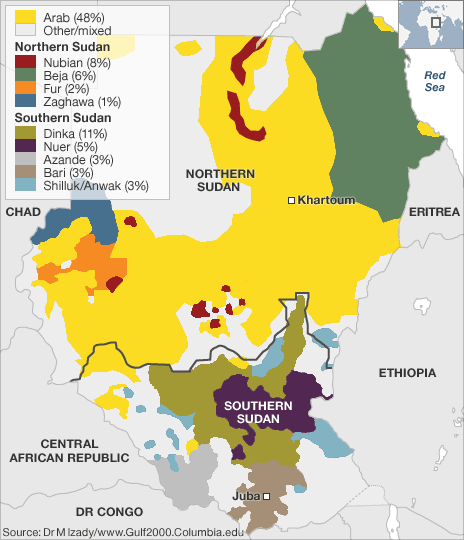
North & South Sudan's ethnic map
“What I realized is that the rebuilding of these churches is much more than rebuilding a facility in which to worship, as important as that is,” Dr. Frist said. “It is a restoration of hope, a rebirth, not just for the congregation but for the entire community.”

Samaritan's Purse has also established a Bible school in the Nuba Mountains, where students are trained to preach the Gospel and plant churches in Arabic-speaking communities.

They also worked with churches in southern Sudan to distribute 260,000 Bibles in six languages and to set up more than 10,000 Bible-reading groups.

The ethnic mix is more complicated both for politics and missions in South Sudan. In northern Sudan, Muslim Arabs make an ethnic majority and do not allow Christian missionaries, but in South Sudan, no ethnic majority exists, and Christianity has thrived in the war-torn region.

A church leader who spoke at the dedication of a rebuilt sanctuary in Yei defined the mission of Sudanese believers when he said: “We now have a beautiful building, but we bring people not to a building, but to Jesus Christ. When we die, let’s leave behind more than a nice building. Let’s leave behind a legacy that makes people say, ‘Surely, that person knew Jesus Christ!’” 

We welcome South Sudan into the family of nation states of the earth.